Marquage laser à fibre vs CO2 : lequel convient à votre matériau ?
Pour le marquage direct sur la plupart des pièces métalliques nues, un laser à fibre constitue généralement le meilleur point de départ. Pour le bois, le papier, le carton et de nombreuses surfaces en cuir, un laser CO2 est généralement le choix le plus adapté. La décision devient moins évidente avec les plastiques techniques, les métaux revêtus, le verre et les matériaux d’emballage, où la formulation de la surface et le marquage requis peuvent compter autant que le nom du matériau.
La question utile n’est pas simplement de savoir quel laser peut laisser une marque visible. Il s’agit de savoir quel procédé peut produire le contraste, la lisibilité, l’état de surface et la régularité requis sur la pièce réelle, dans un cycle de production acceptable. Cette distinction doit guider la comparaison avant que les puissances nominales ou les prix des machines n’entrent en jeu.
Fibre ou CO2 : lequel évaluer en premier ?
Commencez par la surface que le laser touchera réellement. Si un composant en acier inoxydable non revêtu nécessite un numéro de série ou un code Data Matrix, le marquage à fibre est un premier essai logique car il peut modifier ou retirer directement le métal. Si le travail consiste en un codage de dates sur des emballages en carton, le CO2 est généralement la voie la plus appropriée car le matériau réagit facilement à sa longueur d’onde infrarouge.
Le choix est moins évident pour une plaque signalétique en aluminium anodisé coloré ou un boîtier en plastique moulé. Dans ces cas, le revêtement, le pigment, les additifs ou le fini de surface peuvent déterminer quel laser produit un résultat acceptable.
Ces distinctions conduisent à une règle pratique : choisissez le premier laser à tester en fonction de la surface exposée du matériau et de l’effet de marquage requis, et non d’une étiquette générale métal ou non-métal. Un premier choix approprié réduit les essais inutiles ; il ne remplace pas la validation sur des pièces représentatives de la production.
Pourquoi les lasers à fibre et CO2 marquent-ils les matériaux différemment ?
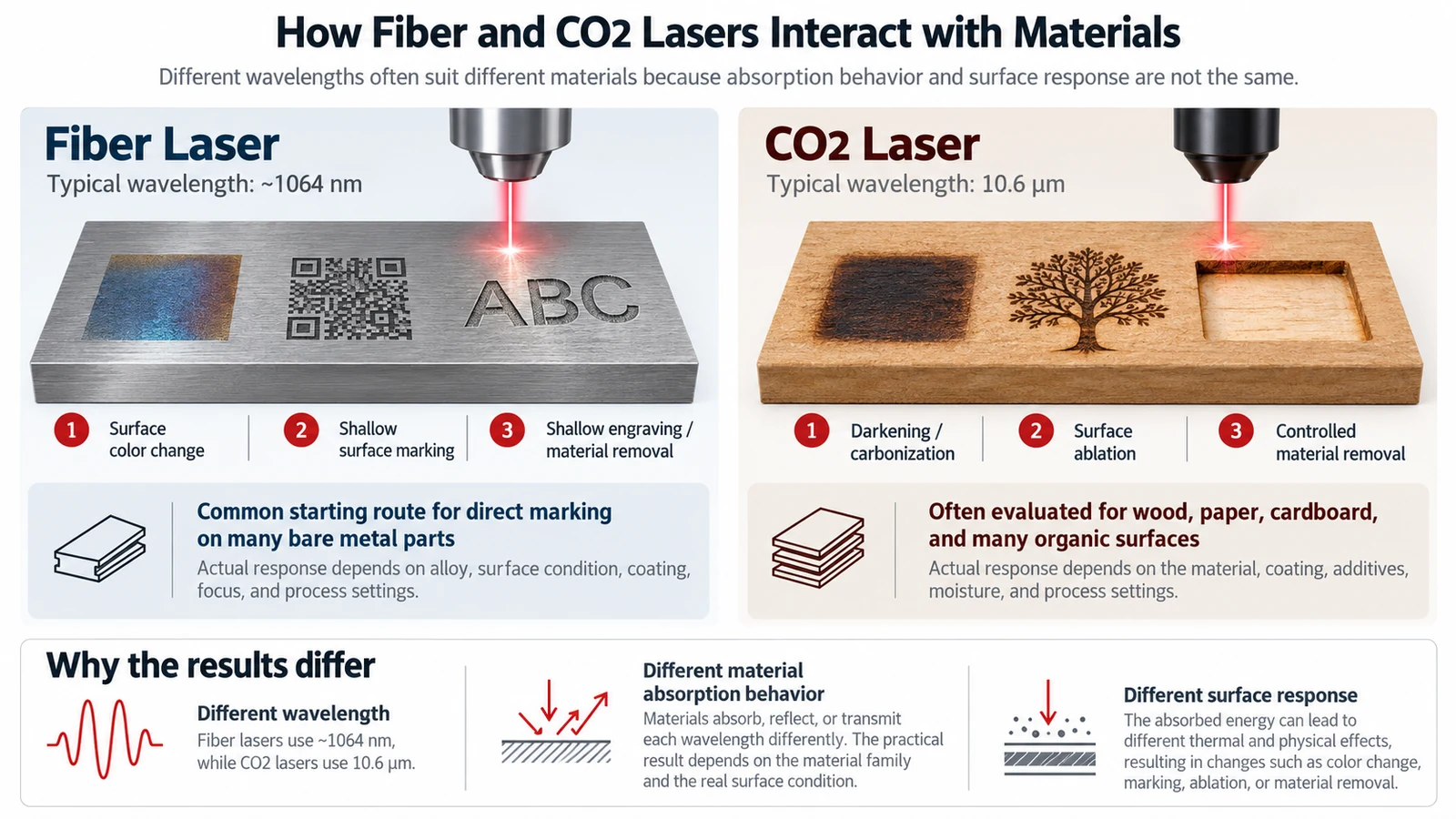
Conventionnel marqueurs laser à fibre fonctionnent couramment près de 1 064 nanomètres, dans la région du proche infrarouge. De nombreux marqueurs industriels CO2 fonctionnent à 10,6 micromètres, une longueur d'onde infrarouge bien plus longue, tandis que certains systèmes utilisent des alternatives telles que 9,3 micromètres pour des substrats particuliers. Ces longueurs d'onde interagissent différemment avec les métaux, les polymères, les revêtements et les matériaux organiques.
L'énergie laser absorbée peut produire plusieurs types de changements : un métal peut développer un contraste de couleur à base d'oxyde ou perdre une petite quantité de matériau de surface ; un polymère peut changer de couleur, mousser, fondre ou voir une couche retirée ; une surface organique peut s'assombrir par décomposition thermique localisée. Le résultat dépend à la fois de la réponse du matériau et de l'énergie délivrée. La longueur d'onde aide à déterminer ce qui est possible, mais elle n'établit pas à elle seule un résultat acceptable.
La transmission du faisceau, la focalisation, le comportement des impulsions, les paramètres de balayage et le temps d'exposition comptent également. Même lorsque la longueur d'onde est adaptée, ces conditions déterminent si le matériau réagit de manière contrôlée et si la marque répond à ses critères d'acceptation.
Quels matériaux et résultats de marquage favorisent chaque laser ?
La compatibilité des matériaux est mieux appréhendée comme une combinaison de substrat, état de surface et résultat requis. Un laser qui crée un fort contraste sur une finition peut créer une marque faible ou une modification excessive de la surface sur une autre.
Métaux nus : marquage direct, contraste et gravure
Les lasers à fibre sont généralement le premier choix pour le marquage direct de l'acier inoxydable non revêtu, de l'acier au carbone, de l'aluminium, du titane et de nombreuses autres pièces métalliques industrielles. Selon l'alliage et les paramètres du procédé, ils peuvent créer des changements de couleur visibles, des marques de surface peu profondes ou des gravures en creux sans appliquer de composé de marquage séparé.
Ces résultats ne sont pas interchangeables. Une marque sombre en surface peut convenir à un code de traçabilité lorsque la pièce doit rester relativement lisse. Une marque en creux peut être requise lorsqu'une profondeur de gravure spécifiée ou une meilleure résistance à l'usure mécanique fait partie des critères d'acceptation. L'obtention de la profondeur implique généralement davantage d'enlèvement de matière et peut augmenter le temps de traitement ou modifier la surface. Sur l'aluminium nu, il ne faut pas supposer qu'une teinte de noir particulière soit réalisable avec toutes les sources à fibre et tous les finis ; le contraste doit être vérifié sur l'alliage et l'état de surface réels.
Un marqueur CO2 conventionnel n'est normalement pas l'option pratique pour graver directement le métal nu. Il peut produire une marque sur le métal avec une pâte, un spray ou un ruban de marquage approprié, mais cela ajoute des étapes de préparation et de nettoyage et constitue un procédé différent de la modification directe du substrat.
Bois, papier, carton et cuir : la réponse de surface compte
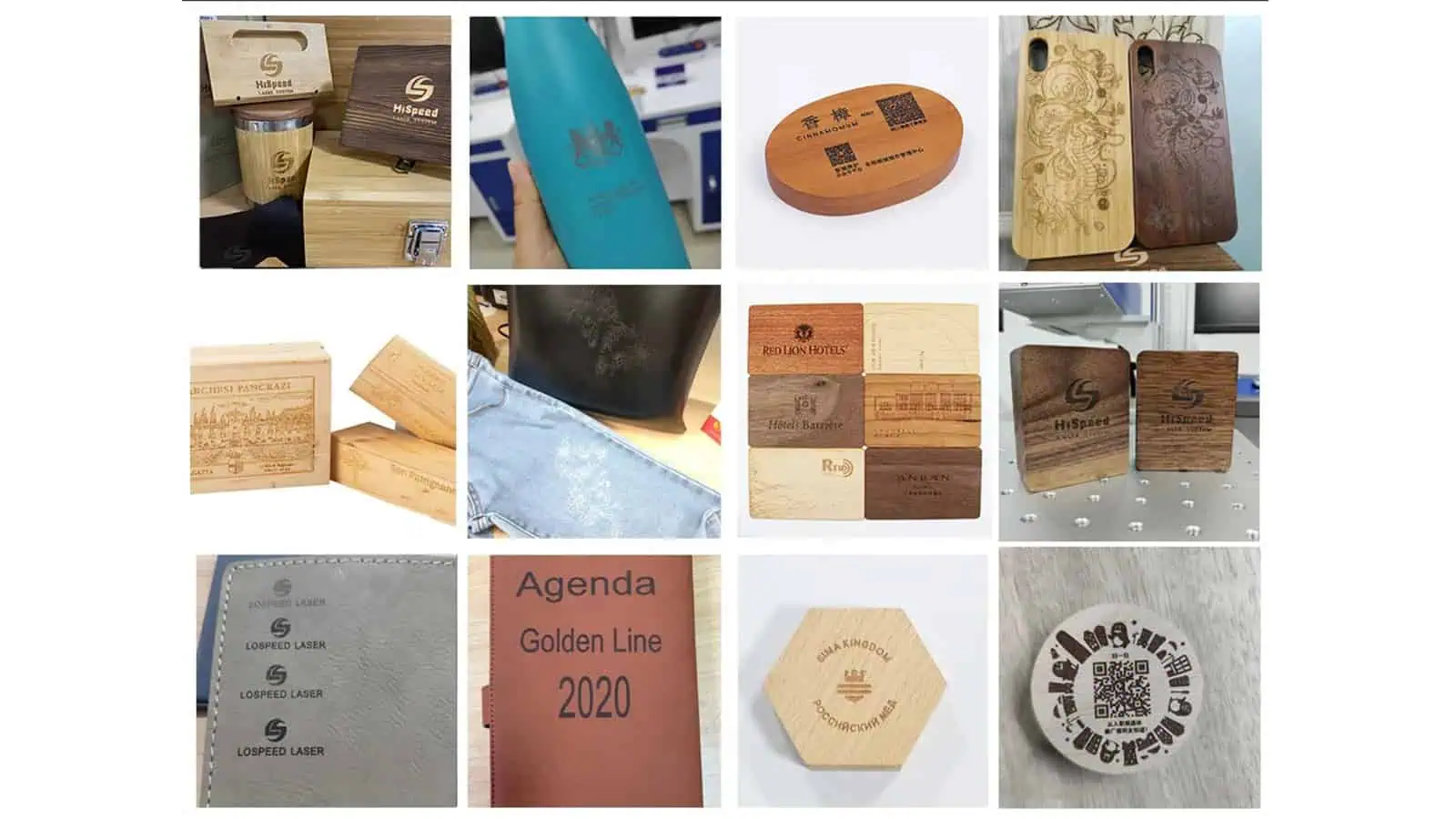
Lasers CO2 sont généralement bien adaptés au bois, au papier, au carton et à de nombreuses surfaces en cuir. Une marque visible peut être créée par noircissement localisé, carbonisation ou enlèvement contrôlé de matière, selon le substrat. Cela fait des lasers CO2 un candidat courant pour les codes d'emballage, l'identification des produits et les marques décoratives ou fonctionnelles sur les matériaux organiques.
Le défi consiste à contrôler cette réponse. Une combustion plus visible n'est pas nécessairement une meilleure marque. Une énergie excessive peut produire du carbonisage, de la suie, des bords de caractères irréguliers, une déformation ou une modification inacceptable d'une surface finie. Le grain du bois, les revêtements du papier, les finitions du cuir, la couleur et l'humidité peuvent tous affecter le résultat.

| Matériau ou surface | Laser à fibre | Laser CO2 | What needs checking |
|---|---|---|---|
| Bare stainless steel, steel, aluminum, and similar metals | Usually the first choice for direct marking or engraving | Generally not preferred for direct bare-metal marking | Contrast, depth, alloy, finish, and permitted surface change |
| Wood, paper, cardboard, and many leather surfaces | Usually not the first choice | Usually the first choice | Darkening, edge quality, charring, and material damage |
| Engineered plastics | Possible with suitable formulations and marking conditions | Possible with suitable formulations and marking conditions | Resin grade, pigments, additives, color, and deformation |
| Anodized, painted, or otherwise coated metals | May mark or modify the surface layer | May mark or remove certain surface layers | Coating type, layer removal, underlying material, and protection requirements |
| Glass and PET containers | Generally not the usual first route for standard transparent surfaces | A candidate for selected glass and PET marking applications | Wavelength, wall thickness, appearance, and structural integrity |
The table narrows the options, but it cannot resolve the difficult cases by itself. In particular, plastics and coated products require a closer look at which layer absorbs the beam and what the marking process is permitted to change.
When Do Plastics, Coatings, and Transparent Materials Change the Answer?
For these materials, the exposed surface may behave very differently from the base material named on a drawing. The following situations show why an initial recommendation sometimes needs closer evaluation.
Before testing an unfamiliar plastic, synthetic leather, or coated material, confirm its composition and laser-processing safety. PVC and some other halogen-containing materials can release hazardous or corrosive fumes under laser exposure and may be unsuitable for laser processing. Do not trial-mark an unidentified formulation simply to see whether a visible code can be produced; establish material suitability and the necessary fume controls first.

Plastics: Resin Grade, Color, and Additives Matter
“ABS,” “PC,” or “PP” is not enough information to predict a reliable laser mark. The actual formulation may include pigments, fillers, flame retardants, or laser-sensitive additives that change how strongly the part absorbs a given wavelength. Some formulations respond well to near-infrared fiber lasers; others may be more suitable for CO2 processing or require a different wavelength altogether.
The desired marking mechanism matters just as much. A laser might create a dark color change with little visible relief, produce a lighter foamed mark on a darker plastic, or remove a thin surface coating to expose a contrasting layer. Those results have different implications for appearance, texture, and functional surfaces. If the plastic melts, warps, becomes brittle, or loses code definition, a visible mark alone is not evidence of a suitable process.
For a molded housing or connector, a meaningful trial therefore needs the actual resin grade, color, additive package where available, and final surface finish. Testing a generic plastic sample does not establish that another formulation will behave the same way.
Coated Metals: Are You Marking the Coating or the Metal?
Consider a dark aluminium anodisé tag. A laser can create a light mark by modifying or removing part of the colored surface layer. Both fiber and CO2 systems can be candidates for certain anodized finishes. But the fact that the part is made from aluminum does not mean the laser has deeply engraved bare aluminum underneath.
Painted or powder-coated parts present a related decision. If the goal is to reveal the base material or a contrasting layer, selective coating removal may provide the right appearance. If the coating serves a corrosion, electrical, or other protective purpose, removing it may be unacceptable even when the code is highly legible. The required outcome must be defined before choosing the process.
Glass, PET, and Thin Packaging: Visible Does Not Always Mean Acceptable
Transparency to visible light does not tell you how a material will respond to a CO2 laser. CO2 markers can produce frosted-looking marks on some glass and PET products, but the mechanism and acceptable process window are different. On glass, localized thermal effects can produce microfractures or surface changes; appearance must be evaluated alongside the risk of chipping or weakening the product.
On PET bottles, even the choice between CO2 wavelengths can matter. Systems operating near 9.3 micrometers may produce a shallower, foamed-looking effect on certain thin-walled PET containers, whereas a 10.6-micrometer process may remove more material. The appropriate choice depends on bottle construction and the required code. A readable date mark is not sufficient if it creates a weak point, pinhole, or other unacceptable change to the packaging.
Thin films and multilayer packaging deserve the same caution. The marking process must preserve any necessary barrier, sealing, and mechanical properties. Where neither fiber nor CO2 can meet the quality requirement without excessive surface change, another marking technology may need evaluation rather than forcing one of these two systems to work.
Which Is Faster or More Cost-Effective in Production?
There is no reliable answer to “Is fiber faster than CO2?” without specifying the material, mark, machine configuration, and production arrangement. A fiber laser may be a natural choice for high-volume metal traceability, while a CO2 coder may be well suited to moving cartons or bottles. Those strengths do not establish a universal speed ranking.
Comparez accepted parts per hour, not a headline scan-speed figure alone. The actual cycle can include part presentation, positioning, focus adjustment, laser exposure, indexing, and any code verification. Mark size, fill pattern, contrast target, required depth, and the number of processing passes also affect the time needed for an acceptable result. A faster-looking trial is not better if the mark fails readability or durability checks.
Ownership cost also depends on the complete installation. The laser source design, optics, cooling requirements, extraction, guarding, fixtures, consumables, and maintenance environment all matter. In particular, a CO2 metal-marking process that relies on spray or paste adds handling steps that a direct fiber-metal process may avoid. Conversely, selecting fiber for a substrate that does not absorb its wavelength effectively can waste money regardless of the machine’s purchase price.
Only compare purchase and running costs after establishing which process can repeatedly meet the specification. Otherwise, the lower-priced machine may simply be the wrong machine.
How Do You Make the Final Choice and Validate the Mark?
The final choice should be based on a trial using production-representative parts and defined acceptance criteria. If both technologies are candidates, evaluate their marks against the same requirements before comparing their production fit.
Follow a Practical Selection Sequence
- Identify the exposed surface. Record the substrate, grade, color, finish, and whether the beam will contact bare material, a coating, or a multilayer structure.
- Define the required result. Specify the code or graphic, its size, target contrast or readability, depth if relevant, and any limits on visible or functional surface change.
- Choose the first trial route. Prioritize fiber for typical bare-metal marking and CO2 for many organic surfaces. Treat plastics, coatings, glass, and packaging as application-specific decisions.
- Test the actual part. Compare acceptable marking quality, edge definition, surface effects, and performance after any required cleaning, handling, or downstream process.
- Compare production fit. Once the marks pass, evaluate cycle time, handling, integration, extraction, guarding, and total operating requirements before settling on a machine configuration.
What Should a Sample Marking Test Confirm?
| Vérifier | Question à résoudre |
|---|---|
| Actual material | Is the sample the specified grade, color, coating, and surface finish? |
| Spécification de marquage | Does the result meet the required text, code size, contrast, and depth where specified? |
| Lisibilité | Can the intended reader or scanner consistently read the mark under realistic conditions? |
| Intégrité de la surface | Are melting, cracking, excessive roughness, coating removal, or other changes within permitted limits? |
| Durabilité | Does the mark remain acceptable after relevant cleaning, abrasion, handling, or downstream processing? |
| Répétabilité en production | Can the process hold the required quality and cycle time with realistic positioning and part variation? |
If the same operation needs direct marks on bare-metal parts and codes on uncoated paperboard, do not assume that one conventional fiber or CO2 source is the best fit for both. Depending on the workflow, compare separate marking stations with a properly configured dual-source system; part handling, production volume, and the required results determine whether either arrangement makes sense.
If both technologies pass, select between them using the actual production trade-offs. If neither passes, reconsider the wavelength, marking mechanism, or material specification instead of compensating with more power alone. For a useful machine-selection review, provide the actual material and finish, a drawing or photograph of the marking area, the code artwork, the acceptance criteria, and the expected production rate.