Portable laser marking systems
Portable Laser Marking Machines
Move the laser marking system closer to large, fixed, or hard-to-move parts. Zhuorui helps match fiber portable machines, portable systems with handheld heads, and CO2 portable options according to the real material, marking area, access condition, machine size, focusing method, and safety setup.
Selection note: Portable does not always mean handheld. A portable laser marking machine may be a compact movable system, a portable system with a handheld marking head, or a CO2 portable route for suitable non-metal materials. The correct choice depends on part size, material, access, repeatability, mark quality, operator control, and the controlled operating area.
- For large or fixed workpieces
- Fiber, handheld-head and CO2 portable routes
- Machine access, source route and safety reviewed together
Equipment styles
What is a portable laser marking machine?
A portable laser marking machine is selected when the marking system needs to approach the workpiece. On this page, the main portable choices are a fiber portable machine, a portable system with a handheld marking head, and a CO2 portable laser marking machine for suitable non-metal materials. Table-style desktop machines belong to desktop or table routes and should not be treated as the main product style here.
Fiber portable machine
The complete fiber laser marking system is moved closer to the workpiece. It is more suitable when the part is large, fixed, heavy, or inconvenient to bring to a normal workstation.
- Common starting route for metal marking
- Better structure control than free handheld positioning
- Needs stable placement and clear focusing access
Portable system with handheld head
The machine system is portable and the marking head may be manually positioned near a fixed surface. This route improves access flexibility but needs stricter operation and safety review.
- Useful for large frames, installed parts, and hard-to-reach surfaces
- Mark quality depends more on focus and operator stability
- Requires controlled area, guarding, and operator training
CO2 portable marking machine
A CO2 portable route is reviewed when the workpiece is suitable for CO2 laser marking and the machine needs to be repositioned around the part or work area. It is not a default choice for direct bare-metal marking.
- Relevant for wood, paper, leather, fabric, and some organic materials
- Not the first choice for direct bare-metal marking
- Needs material, fume, cooling, and safety review before final selection
Why choose portable
Choose portable marking when moving the part is harder than moving the machine
Portable laser marking is mainly a handling decision. It helps when the workpiece is too large, already installed, heavy, awkward to fixture, or marked in different areas. It is not automatically better than a desktop, enclosed, or inline machine.
Large or fixed parts
Use a portable machine when the part cannot be easily placed on a normal worktable, such as heavy metal components, equipment frames, large tools, machinery surfaces, or installed assemblies.
Multi-location workshop work
A portable route can support maintenance marking, repair areas, warehouse marking, or workshop stations where the marking task changes location but still needs a real laser marking system.
Access-constrained surfaces
When the mark position is reachable but the part cannot be repositioned, a handheld-head route may be considered. The focus, posture, repeatability, and safety boundary must be reviewed carefully.
Advantages and limits
Advantages and limits of portable laser marking machines
The advantage of portability is access. The limitation is that open-site marking is harder to control than a fixed workstation. A good selection should evaluate both sides before quotation.
| Side | What it means | Buyer decision point |
|---|---|---|
| Advantage: flexible access | The machine or marking head can be brought closer to a large, fixed, or difficult-to-move workpiece. | Useful when workpiece handling cost is higher than machine movement cost. |
| Advantage: suitable for field or workshop tasks | Portable marking can serve maintenance, repair, identification, and multi-location workshop needs. | Confirm destination power, movement method, operator access, and safety area. |
| Limit: repeatability is harder | Focus distance, head position, hand stability, and part surface angle can vary more than in a fixed workstation. | Use fixtures, stops, positioning aids, or a more controlled structure when repeat quality is important. |
| Limit: safety control is more complex | Open or handheld marking requires a defined restricted area, beam-stop plan, eyewear policy, training, and smoke control. | If safety control must be simple, compare enclosed laser marking machines first. |
| Limit: not always best for batch speed | Portable marking may increase setup time and operator involvement compared with desktop fixtures or flying production-line marking. | For high-volume repeat parts or continuous coding, review fixed, enclosed, or flying routes. |
Portable machine categories
Choose the portable machine by material, access, and marking structure
This page focuses on portable structures that solve large-part or hard-to-move-part marking. Table-style desktop machines are not presented as a main product card here because they belong to a different structure decision.
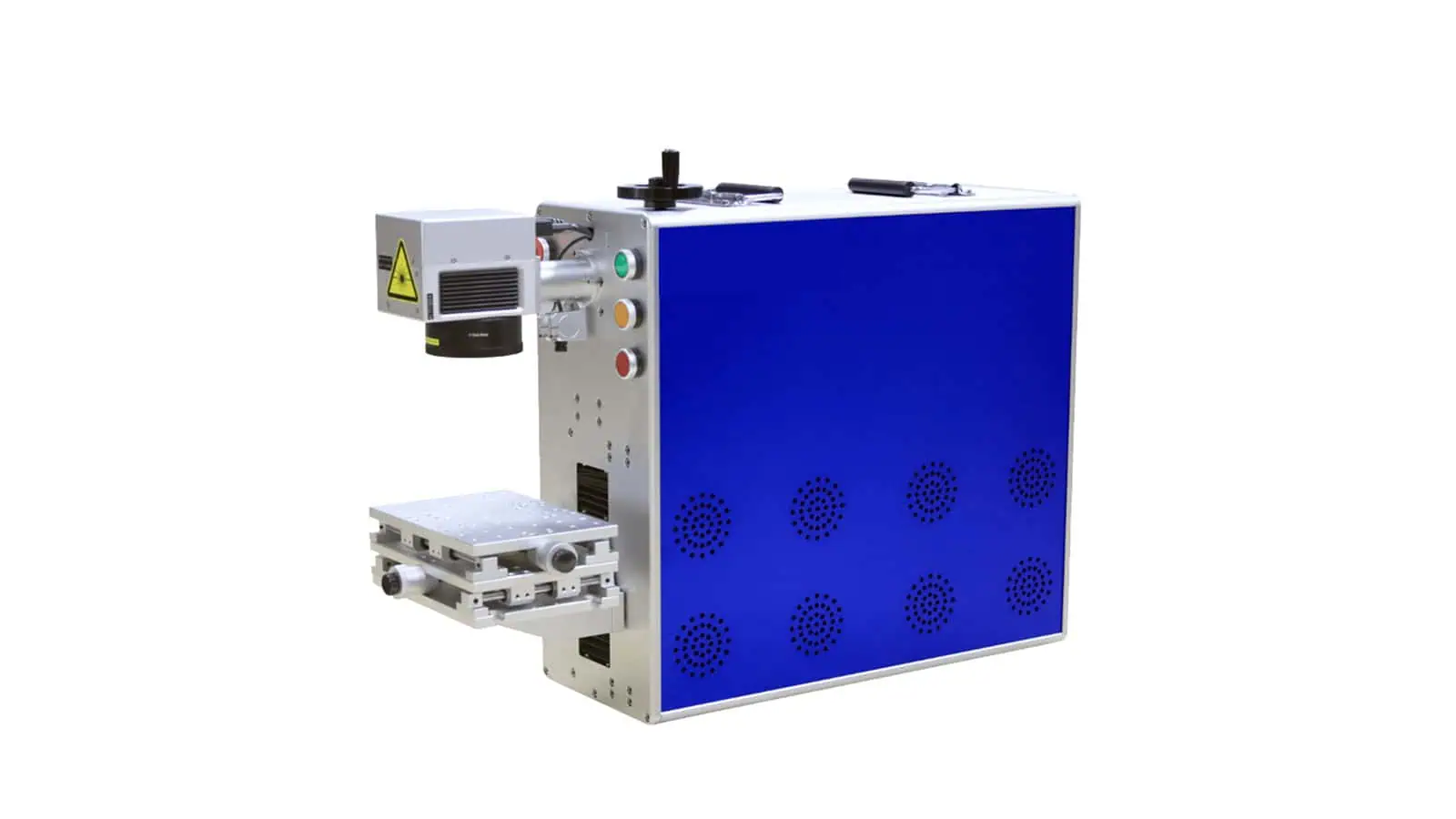
Fiber portable machine
Fiber Portable Laser Marking Machine
A movable fiber laser marking system for large metal parts, fixed components, equipment surfaces, tools, plates, and workshop areas where a normal bench station is difficult to use.
Review fiber portable route →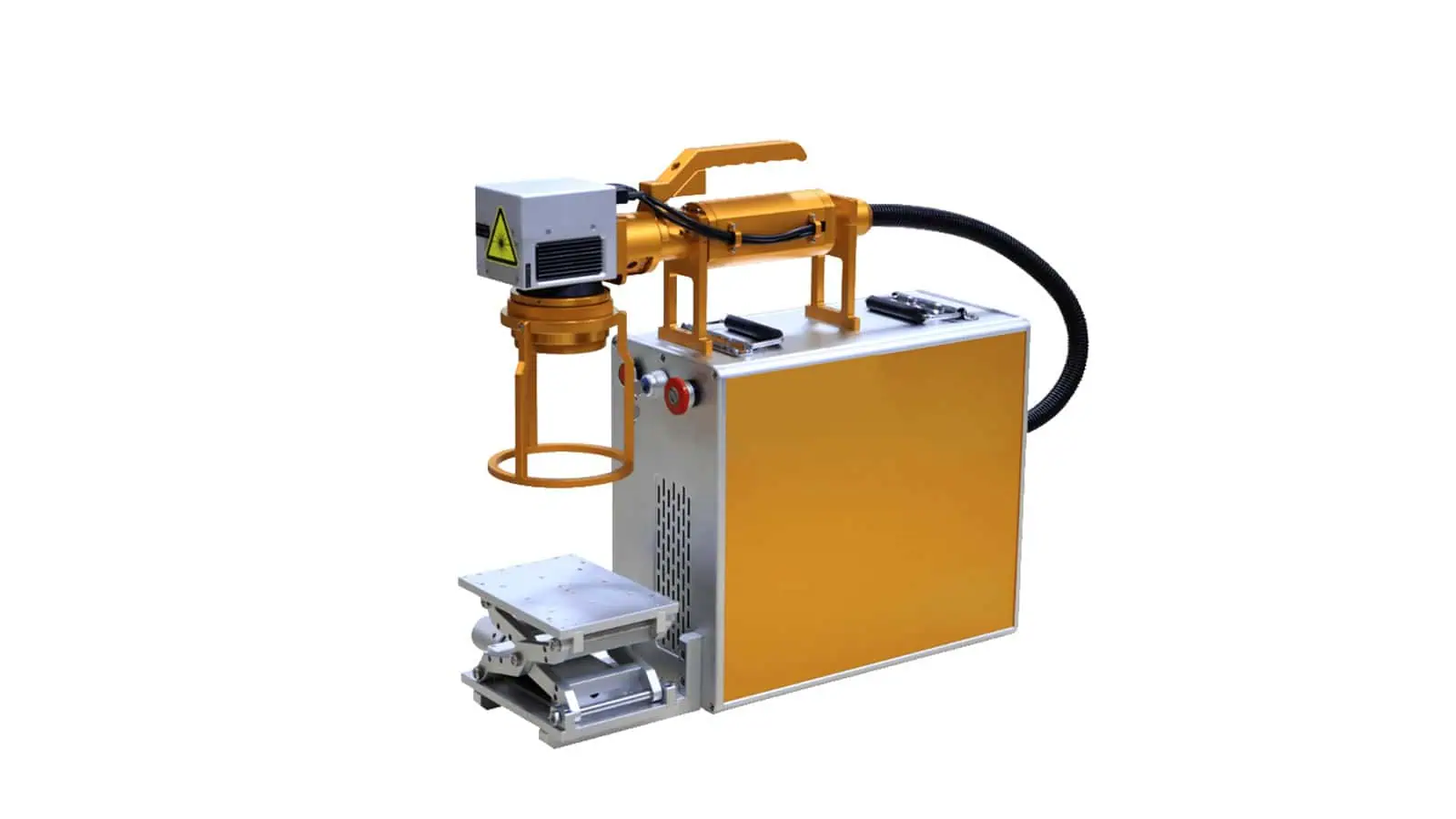
Portable system with handheld head
Portable Laser Marking System with Handheld Head
A portable marking system for access-constrained workpieces where the marking head needs to reach a fixed surface, assembled component, large frame, or part that cannot be placed on a table.
Review handheld-head portable route →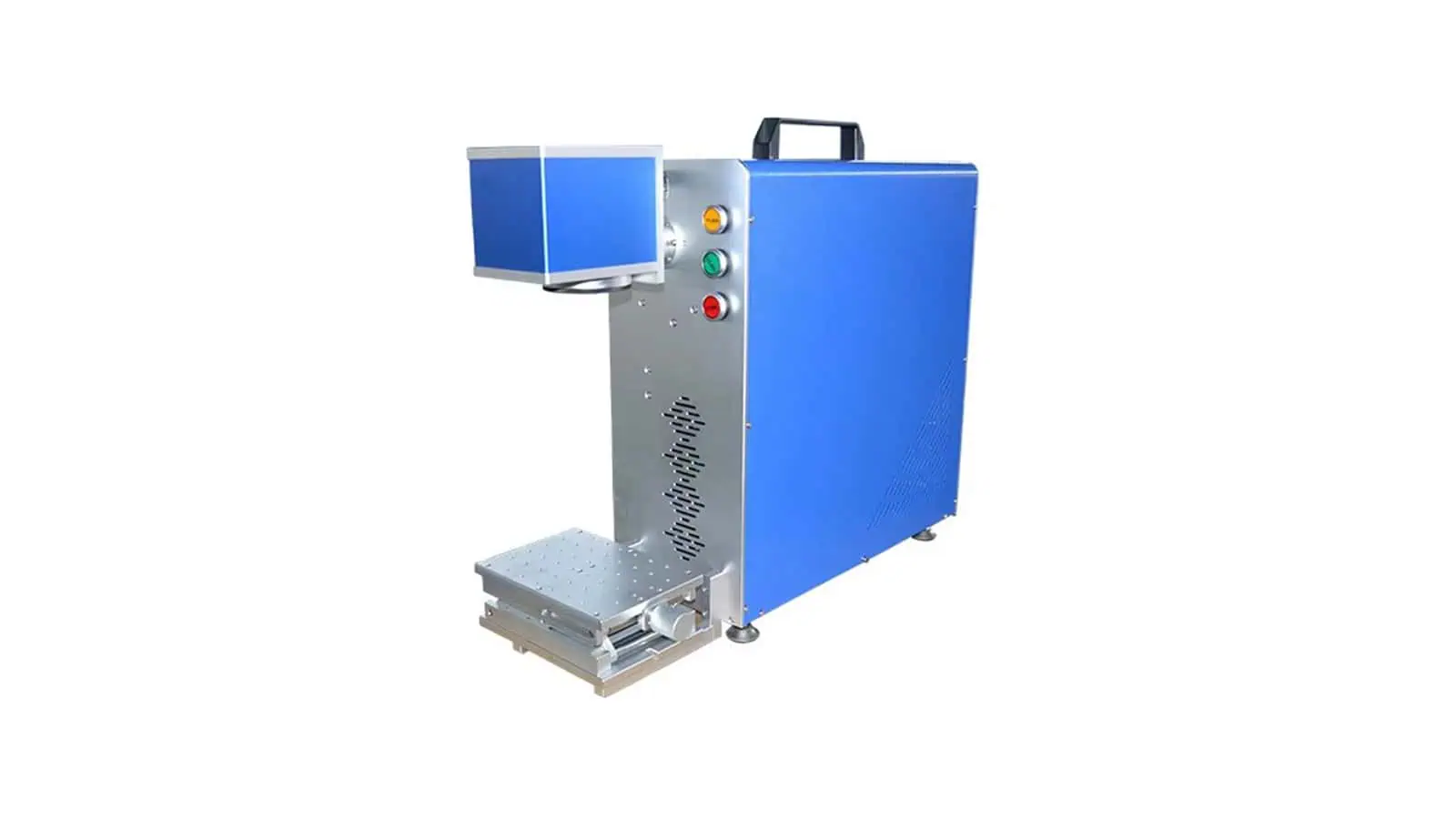
CO2 portable machine
CO2 Portable Laser Marking Machine
A portable CO2 laser marking route for suitable non-metal and organic materials when the marking equipment needs to be moved around the workpiece, workshop area, or local production site.
Review CO2 portable route →Why table-style machines are not listed as a main portable category
A table-style fiber laser marking machine is useful, but it should not be presented as a main portable-machine style on this page. If the workpiece can be placed on a local worktable, compare desktop, table, or enclosed laser marking machines first. If the workpiece cannot move easily, stay with the fiber portable, handheld-head portable, or CO2 portable route according to material and access.
Laser source routes
Portable structure is one decision; laser source is another decision
Do not choose a portable machine by appearance or wattage alone. The source route still depends on material, surface condition, mark target, contrast or depth requirement, heat sensitivity, fume risk, and sample result.
Fiber laser route
Fiber is the common starting route for metals, coated metals, tools, plates, machinery parts, nameplates, stainless steel, aluminum, brass, and many industrial identification tasks.
MOPA fiber route
MOPA fiber can be reviewed when pulse control matters, such as more sensitive surface behavior, stainless steel color tendency, aluminum marking, or applications that need a wider process window.
UV laser route
UV is often reviewed for heat-sensitive plastics, glass, films, coatings, cable jackets, and fine cosmetic marks where fiber may burn, deform, or discolor the surface.
CO2 laser route
CO2 is reviewed for wood, paper, cardboard, leather, fabric, organic materials, selected plastics, coated surfaces, and packaging substrates when the material absorbs the wavelength properly. It should not be selected for direct bare-metal marking without a specific material and process review.
Size, weight, and access
How to confirm portable machine size, weight, and working access
For portable machines, dimensions are not only shipping data. Machine size, net weight, head reach, focus distance, cable route, and destination space decide whether the machine can actually be used around the part.
| Item to confirm | What to check | Why it affects selection |
|---|---|---|
| Machine body size | Overall length, width, height, controller position, handle or wheel arrangement, and whether the machine can enter the work area. | A portable machine must fit the real site, not only the shipping carton. |
| Net weight and movement method | How many people move it, whether a cart is needed, floor condition, step or ramp access, and storage position. | Too much weight or poor movement access can make the portable route impractical. |
| Marking head reach | Head position, arm reach, cable length, head angle, and whether the field lens can face the mark area correctly. | The machine is only useful if the head can reach the marking area with a stable lens-to-part relationship. |
| Focus distance and part height | Lens working distance, surface angle, height difference, uneven surface, and whether focus can be repeated after moving. | Focus error can reduce contrast, distort codes, or make the mark inconsistent. |
| Packing size and delivery condition | Carton or wooden case size, accessories, computer, cables, lens, stand, cooling system, extraction equipment, and optional fixtures. | Packing and configuration affect freight, installation, and what the buyer receives. |
Fiber / UV / CO2 selection
How to choose Fiber, UV, or CO2 for portable marking
The right laser source is determined by the real material and target result. Portable structure solves access; wavelength and process behavior solve the marking effect.
- Choose Fiber first for most metal parts, coated metal components, stainless steel, aluminum, tools, industrial plates, machinery parts, and durable identification.
- Review MOPA Fiber when pulse control, surface sensitivity, stainless steel color tendency, or wider parameter adjustment may be important.
- Review UV first for heat-sensitive plastics, glass, films, coatings, cable jackets, fine cosmetic marks, or applications where fiber may burn or deform the surface.
- Review CO2 first for paper, cardboard, wood, leather, fabric, organic materials, selected plastics, coated surfaces, and some packaging substrates. Do not use CO2 as the default route for direct bare-metal marking.
Structure comparison
Portable vs desktop, enclosed, split, handheld, and flying laser marking machines
Portable is only one structure route. Compare it with adjacent machine structures before final selection, especially when repeatability, safety, line speed, or part loading is more important than machine mobility.
| Structure | Best use | Compare against portable when |
|---|---|---|
| Fiber portable machine | Large, fixed, heavy, or hard-to-move metal parts where the machine must approach the workpiece. | The workpiece cannot easily be moved to a desktop or enclosed workstation. |
| Portable system with handheld head | Access-constrained marking where the head needs to reach a fixed or assembled surface. | The mark area is reachable, but focus stability, operator movement, and safety can be controlled. |
| CO2 portable machine | Suitable non-metal and organic materials where the equipment needs to be repositioned around the work area. | The material is not suitable for fiber marking, is not a direct bare-metal task, and the part still needs a movable marking setup. |
| Desktop machine | Small parts, repeat work, local workstation use, and more stable part presentation. | The part can be placed on a table and repeatability is more important than mobility. |
| Enclosed machine | Small-to-medium parts that benefit from a controlled enclosure and more managed operator access. | Safety control, smoke control, and repeat production are more important than on-site marking flexibility. |
| Flying / inline machine | Continuous production-line marking for moving products, packaging, cables, pipes, or coded items. | The main requirement is line speed, triggering, encoder matching, and production flow rather than moving the machine manually. |
When not to choose portable
When a portable laser marker is not the best choice
A portable laser marking machine is useful, but it is not a universal replacement for desktop, enclosed, or inline systems. Choosing portable in the wrong scenario can create repeatability, safety, and production-efficiency problems.
High-volume small parts
When small parts can be loaded into a fixture or tray, a desktop or enclosed workstation usually gives better repeatability, easier focus control, and more stable batch operation.
Strict enclosed safety requirement
If the buyer needs a controlled enclosure, interlock logic, restricted access, and easier operator management, an enclosed machine should be reviewed before an open portable route.
Continuous production-line coding
If the products move on a conveyor, cable line, pipe line, or packaging line, a flying or inline laser marking system is usually more appropriate than a manually positioned portable machine.
Ultra-fine mark with unstable hand control
Very small text, fine codes, or strict cosmetic marks may not be suitable for handheld operation unless focus, distance, surface position, and operator movement can be controlled.
Unsafe open working area
Portable marking should not be used casually in a busy area without shielding, access control, beam-stop planning, eyewear policy, smoke control, and trained operators.
Wrong laser-material match
Portable structure does not fix a wrong source choice. Fiber, UV, and CO2 routes must be reviewed by material response. CO2 portable marking should not be treated as a direct bare-metal marking solution by default.
Delivery content
What is included in a portable laser marking machine delivery?
The final delivery depends on the selected configuration. Zhuorui supplies and configures complete laser marking machines, with source route, optics, controller, software, accessories, packaging, and optional functional parts confirmed before quotation.
Main machine
Portable machine body, laser source route, marking head, galvo scanner, field lens, controller, power supply, cables, and machine structure according to the selected model.
Control and software
Marking control system, compatible marking software, computer or control interface when included in the selected package, and basic parameter setup for the confirmed marking task.
Optional accessories
Rotary axis, fixture, support stand, positioning aid, smoke extraction, protective configuration, foot switch, trigger device, cooling unit, or other accessories depending on project needs.
Packaging and support
Export packaging, configuration confirmation, sample or application review when required, operation guidance, and after-sales support according to the order scope.
Important quotation boundary
Do not assume every accessory is included by default. Lens field, laser source, rotary axis, smoke extractor, fixture, protective parts, cooling system, computer, packing method, and spare parts should be confirmed in the quotation or proforma invoice.
Applications
Typical applications for portable laser marking machines
Portable laser marking is mainly used where part handling is difficult. The final laser route and configuration still depend on material, surface, mark target, and acceptance method.
Large metal parts
Industrial plates, frames, heavy components, and large workpieces that are difficult to load onto a fixed worktable.
Installed equipment
Machinery surfaces, assembled systems, maintenance components, and equipment that needs identification after installation.
Tools and molds
Tool bodies, mold plates, fixtures, dies, repair parts, and workshop identification marks.
Nameplates and tags
Metal nameplates, rating plates, asset tags, product labels, and traceability plates used on equipment or components.
Wood and packaging
CO2 portable marking can be reviewed for suitable wood, paper, cardboard, labels, and packaging materials when the material response is confirmed.
Leather and fabric
CO2 portable marking may suit selected leather, fabric, and organic surfaces after material, coating, fume, and safety review.
On-site maintenance marking
Repair marks, replacement identification, equipment coding, and asset marking in maintenance or service environments.
Workshop multi-location marking
Small-batch identification tasks across different areas when a fixed production station is not practical.
RFQ preparation
What to send for a portable laser marking machine quotation
Portable selection becomes faster when the request includes both workpiece information and site information. Photos are especially important because the main difficulty is usually access, not only material.
| Information | What to provide | How it helps selection |
|---|---|---|
| Part details | Part photos, drawing if available, material, surface coating, part size, part weight, and mark position. | Confirms whether portable structure is needed and which laser route should be reviewed. |
| Marking requirement | Text, logo, serial number, QR code, Data Matrix, mark size, contrast, depth, or cosmetic expectation. | Determines source route, lens field, parameter testing, and acceptance method. |
| Access condition | Photos of the work area, available approach direction, working height, nearby obstacles, and whether the part can be moved. | Helps decide fiber portable, portable system with handheld head, CO2 portable, or another machine structure. |
| Production condition | Quantity, batch size, cycle target, operator process, power supply, smoke extraction, cooling need, and inspection method. | Prevents a portable machine from being selected when desktop, enclosed, or flying marking would be more efficient. |
| Safety requirement | Operator access, surrounding personnel, reflective surfaces, restricted area, eyewear policy, fume control, and local safety rules. | Portable and handheld-head marking require a complete operating boundary, not only a machine quotation. |
FAQ
Portable laser marking machine questions
What makes a laser marking machine portable?
A portable laser marking machine is a complete marking system designed to be moved closer to a workpiece or used in different work areas. It still needs stable placement, proper focusing, suitable power supply, and a controlled operating area.
Is a portable laser marking machine the same as a handheld laser marker?
No. Portable describes the movable system. Handheld describes an operator-held or manually positioned marking head. A portable system may include a handheld head, but handheld operation needs additional review for focus, stability, repeatability, and safety.
Can portable laser marking machines use CO2 laser?
Yes, a CO2 portable laser marking machine can be reviewed when the material is suitable for CO2 marking and the equipment needs to be moved or repositioned. CO2 is more relevant for many organic and non-metal materials, but it is not the default choice for direct bare-metal marking.
Why is the table-style machine not shown as a main product card here?
A table-style machine is closer to a desktop or local workstation route. If the workpiece can be placed on a table, desktop or enclosed machine selection is usually a better comparison. This page focuses on marking systems used when the part is large, fixed, or hard to move.
When should I choose portable instead of desktop or enclosed marking?
Choose a portable route when the part is too large, heavy, fixed, assembled, or awkward to place inside a normal work area. If the part can be brought to a fixed workstation, a desktop or enclosed machine may provide easier positioning, better repeatability, and simpler safety control.
Can a portable laser marker work on plastic or glass?
It depends on the material, surface, mark target, and laser source. Fiber is often reviewed first for metal parts. UV may be more suitable for many heat-sensitive plastics, glass, films, and fine cosmetic marks. CO2 may be considered for selected plastics or coated surfaces, depending on composition and test results.
Can I choose a portable laser marking machine by wattage alone?
No. Wattage is only one factor. Wavelength, pulse behavior, lens field, focus distance, material, surface coating, mark size, code readability, fixture method, operator stability, fume control, and safety boundary can all change the correct configuration.
What should I send for a portable laser marking review?
Send part photos, drawings if available, material and surface information, mark content, mark size, desired effect, access photos, work-area conditions, target quantity, cycle target, power supply information, and any safety or inspection requirements.
Request a quote
Match a portable laser marking route to your real part and work area
Send the part details, material, surface condition, required mark, access photos, destination work area, target quantity, and acceptance method. Zhuorui can review whether a fiber portable machine, a portable system with handheld head, a CO2 portable machine, UV route, or another laser marking structure is more suitable.