Titanium Laser Marking: Fiber, Color, Traceability & Engraving Guide
Titanium can be laser marked for dark identification, oxide color, fine serial data and shallow engraving. The right process depends on the titanium grade, surface condition, target appearance and whether material removal is acceptable. Pulsed fiber lasers are a practical starting point for permanent titanium marks. MOPA fiber is one fiber-laser option with wider pulse-control flexibility, but it is not a titanium-specific requirement and the final process must be developed on the actual grade and finish.
Request Sample Test Contact Zhuorui LaserCan Titanium Be Laser Marked?
Yes. Titanium is well suited to laser marking, but “titanium” alone is not enough information to lock a process. The grade or alloy, surface finish, cleanliness, target mark and downstream acceptance criteria all influence the result.
Grade / Alloy
Confirm whether the part is commercially pure titanium or a titanium alloy such as Ti-6Al-4V. A process window developed on one grade should not be assumed to transfer unchanged to another.
Surface Condition
Polished, brushed, bead-blasted, oxidized, coated or contaminated surfaces can change apparent contrast, oxide color response and code readability.
Target & Acceptance
Define whether the mark needs contrast, color, depth or machine-readable data, then confirm how it will be judged after cleaning, handling or downstream processing.
Titanium Grade and Surface Condition Matter
Commercially pure titanium and titanium alloys should not be treated as one identical marking surface. A process developed on one grade and finish may need adjustment when alloy chemistry, texture or surface treatment changes.
Commercially Pure Titanium
Grades such as Grade 2 are common where corrosion resistance, formability and low density matter. For laser marking, confirm the exact grade and final surface condition before judging contrast or color repeatability.
Titanium Alloys
Ti-6Al-4V, commonly known as Grade 5, is widely used in higher-strength applications. Its alloy composition and finish can respond differently from commercially pure titanium, so parameters should be verified on the actual part.
Polished
High reflectivity makes visual contrast and color judgment more sensitive to lighting and viewing angle.
Brushed / Matte
Texture changes apparent contrast and can influence the readability of small codes and fine characters.
Bead-Blasted
Rougher matte surfaces reduce glare but can make color appear less uniform or alter how small details are perceived.
Oxidized / Coated
First determine whether the laser should modify the titanium itself or remove/change a surface layer. The marking mechanism may be different.
How Laser Marking Changes Titanium
The useful distinction is not simply “marked or not marked.” Titanium can be surface-modified, oxidized for color, or physically removed. These routes create different appearance, durability and surface-integrity requirements.
Surface Contrast
Controlled laser interaction can create a darker visible mark with limited material removal. The exact tone depends on grade, finish, cleanliness and process window.
Oxide Color
Laser heating can change the titanium oxide layer. Different oxide conditions change how light is reflected, which is why titanium can show blue, purple, gold and other colors without adding ink.
Material Removal
Higher accumulated energy can move the process into ablation or engraving. Depth, roughness, debris, edge quality and downstream acceptance then become more important.
Titanium Laser Marking Results
Dark contrast, oxide color and shallow engraving are different surface outcomes. Compare the required appearance, material removal and acceptance criteria before selecting the laser route and process window.
| Marking effect | Best suited for | Main process concern | Validation |
|---|---|---|---|
| Dark / gray surface mark | Permanent identification, part numbers, logos | Contrast changes with grade, finish and cleaning state | Readability, cleaning response, abrasion or handling requirement |
| Oxide color mark | Visual coding, decorative marking, branding | Color is sensitive to oxide condition, surface finish and process repeatability | Target color range, viewing condition, cleaning and batch consistency |
| Shallow engraving | Durable identification where material removal is acceptable | Depth, roughness, edge quality, debris and heat appearance | Depth requirement, cleaning, downstream process and surface-integrity acceptance |
Serial Numbers and DataMatrix Codes on Titanium
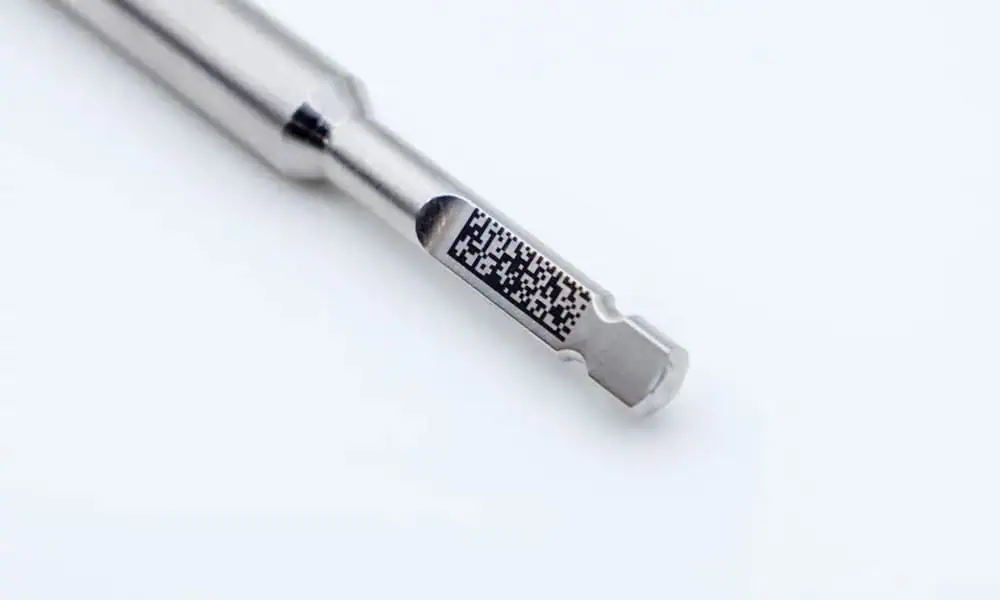
A DataMatrix, QR code or serial number is the information carried by the mark, not a separate marking mechanism. For small codes, the important variables are module size, contrast, quiet-zone condition, focus stability and the final reader or verification requirement.
On curved or textured titanium parts, code geometry and local focus can be more important than simply increasing laser power. If a formal DPM grade is required, define the verification standard and inspection method before the sample test.
Titanium Color Repeatability and Durability
Titanium can develop interference colors when a pulsed laser controls the growth of the surface oxide layer. The result depends on the titanium grade, finish, cleanliness, focus and laser energy delivery. A stainless-steel MOPA color chart is not valid evidence for titanium and its parameters must not be transferred to titanium.
Repeatability
Keep grade, finish, cleaning state, focus and parameter control consistent. A process proven on one batch should still be checked when the incoming surface changes.
Viewing Condition
Interference-type colors can look different under different lighting or viewing angles. If color is an acceptance criterion, define how it will be inspected.
Cleaning & Handling
Fingerprint resistance, cleaning chemistry and handling requirements should be tested if appearance must remain stable in use.
Durability
Do not assume that visible color automatically proves abrasion, chemical or long-term durability. Validate the specific exposure conditions required by the application.
Fiber or MOPA Fiber for Titanium?
Both are pulsed fiber-laser routes and both can be used on titanium. MOPA is not required simply because the workpiece is titanium; its main advantage is a wider adjustable pulse window, which can be useful when tuning oxide color, heat input or low-removal surface effects. Final settings must be developed on the actual titanium grade and finish.
| Project condition | Starting direction | What to verify |
|---|---|---|
| General serials, logos and permanent ID | Standard fiber is a practical starting point | Contrast, readability, cleaning and heat appearance |
| Shallow engraving | Fiber or MOPA depending on depth and surface requirement | Depth, edge quality, roughness, debris and cycle time |
| Controlled oxide color | Pulsed fiber; evaluate MOPA when wider pulse-width control is useful | Color repeatability, surface finish sensitivity and batch stability |
| Fine dark mark with limited removal | MOPA is worth testing when surface control matters more than depth | Contrast, roughness, heat effect and cleaning response |
| Coated or treated titanium | Determine whether the process acts on coating or base titanium before choosing settings | Layer response, exposed substrate, contrast and post-process acceptance |
Where Titanium Laser Marking Is Used
Titanium marking is common where durable identification, compact traceability or controlled visual marking is needed on high-value components. Typical examples include medical components, aerospace parts, industrial hardware, watch and jewelry parts, electronics hardware and specialty consumer products.
For curved parts, complex fixtures, production-line marking or automated traceability, evaluate the titanium marking result together with positioning, focus control, data handling and cycle requirements. When these production factors are part of the project, continue to Applications or the relevant solution page.
Surface Integrity and Post-Process Requirements
The acceptable process window changes when the part has strict surface, cleaning, corrosion, dimensional or regulatory requirements. “The mark looks good” is not the same as proving the marked part still meets its downstream specification.
Material Removal
Engraving intentionally removes material. Confirm whether depth, local roughness, burr or edge condition is acceptable for the part.
Heat & Appearance
Visible heat tint, oxide color or surrounding discoloration may be acceptable in one application and unacceptable in another. Define the cosmetic boundary before testing.
Cleaning & Downstream Processes
Cleaning, passivation, coating, sterilization or other post-process steps can change the final appearance or acceptance result. Test the complete process sequence when these steps matter.
What Zhuorui Laser Needs to Evaluate Titanium Samples
Material Details
- Titanium grade or alloy
- Surface finish and cleaning state
- Coating, oxidation, passivation or post-process step
Mark Details
- Artwork, serial or code file
- Mark size, location and geometry
- Desired dark mark, color or engraving depth
Acceptance Details
- Reader or verifier requirement
- Color, cleaning, abrasion or handling test
- Surface-integrity or downstream process requirement
Titanium Laser Marking FAQ
Do I need a MOPA laser to mark titanium?
No. Standard fiber is a practical starting point for many serial numbers, logos and shallow engraving tasks. MOPA becomes more valuable when tighter pulse control, controlled color or a more tightly managed surface effect is required.
Can a fiber laser make color on titanium?
Titanium can develop oxide colors under controlled laser heating. The exact achievable range and repeatability depend on the laser source, pulse control, focus, grade, finish and process window, so color should be proven on the real part.
Is titanium laser color permanent?
The color comes from a surface oxide condition rather than printed pigment, but visible color alone does not prove a specific abrasion, chemical or cleaning durability requirement. Test the exposure conditions that matter to the application.
Can Ti-6Al-4V be laser marked?
Yes. Ti-6Al-4V is commonly laser marked, but parameters and acceptance should be established on the actual Grade 5 surface rather than copied directly from commercially pure titanium or a different finish.
Send Titanium Samples for Marking Evaluation
Share the titanium grade, surface finish, target mark, required color or depth, code-verification needs and downstream acceptance tests. Zhuorui Laser can use sample testing to narrow the fiber or MOPA configuration before final machine selection.
Request a Quote Contact Us