
POM Acetal Laser Marking
Qualify POM, acetal or polyoxymethylene by resin grade, color, additive package, contrast target, odor control and process window before choosing a laser marking machine. POM can be useful for precision parts, but it is formulation-sensitive and should not be approved from the material name alone.
Request a POM Sample Test Ask About POM CompatibilityPOM Can Be Laser Marked, but Contrast and Odor Must Be Managed Together
POM acetal is a semi-crystalline engineering plastic used for precision, wear and low-friction parts. Laser marking is possible, but POM often has a narrower usable process window than plastics that naturally absorb near-infrared energy well. Black, filled or laser-markable POM can behave very differently from natural or white POM.
Contrast is grade-specific
Black POM may create usable contrast under selected fiber parameters, while natural or white POM can need additives, masking, UV/green screening or another route.
Odor is a process warning
If the mark requires heavy burning, strong odor or visible decomposition, the result may be outside a sensible production window even when the text is readable.
Parameters cannot be copied blindly
Power, frequency, speed, hatch spacing, focal condition and number of passes interact. A setting that works on one POM slab may fail on another color, molded surface or additive package.
Do Not Choose a Laser from “POM” Alone
A useful recommendation needs three inputs together: the exact acetal material, the mark you need, and the way the part will be produced. The same POM family can require a different laser source, lens, fixture or extraction setup when color, code size, geometry or cycle time changes.
Material condition
Confirm POM-C or POM-H, supplier grade, color, fillers, lubricants, laser-marking additives, molded or machined surface, and any compliance restrictions.
Mark requirement
Define whether you need visible identification, a logo, a serial number, a small Data Matrix, a cosmetic mark or a deeper textured result.
Production condition
Provide part geometry, marking area, loading method, required parts per hour, inspection method and any fixture, rotary, vision or automation constraints.
Which Acetal Grade Are You Actually Marking?
POM is not one laser-marking behavior. Homopolymer, copolymer, color, fillers, lubricant packages, food-contact requirements, medical restrictions and machined surface finish can all change the acceptable process window.
POM-C copolymer
Common acetal route with many industrial grades. Confirm whether it is standard, filled, colored, laser-markable or intended for food, medical or conveyor contact.
POM-H homopolymer
Often associated with Delrin-type acetal. It should be tested separately because crystallinity, thermal response and supplier grade can shift the window.
Black or dark POM
Dark pigments may improve absorption and contrast in some near-infrared tests. Still check surface roughness, ablation, odor and code readability.
White or natural POM
Often more difficult for direct dark marking. A laser-markable grade, additive, masking method, UV or green screening may be worth evaluating.
Laser-Markable White Acetal Can Produce a Very Different Response
This white POM/acetal example shows why the exact resin formulation matters. A laser-markable grade can produce a dark, readable result that should not be assumed for ordinary natural or white POM.
Use this image as a POM material-response example, not as a universal performance guarantee. Final approval still depends on the actual production grade, surface and marking requirement.
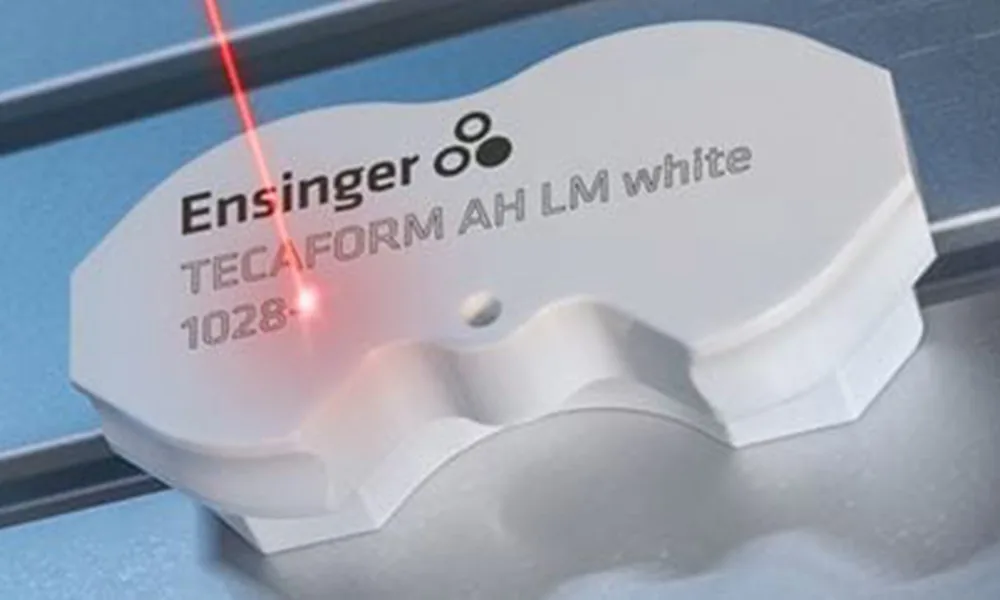
Laser-markable POM is a material choice, not only a machine setting
Some modified POM-C grades are designed to create high-contrast laser marks. If the product design allows a resin change, compare a laser-markable acetal with the current grade before forcing a narrow, smoky parameter window on standard POM.
Where POM Is Used and Why These Parts Need Marking
POM is commonly selected for low-friction, wear-resistant and dimensionally stable components. On these parts, laser marking is usually needed for identification, traceability, assembly control or visible product information rather than decoration alone.
Automotive clips, guides and mechanisms
Typical needs include part numbers, supplier codes, lot information and assembly identification on small molded acetal components.
Electrical and electromechanical parts
Connectors, switch components and insulating mechanisms may need model IDs, orientation marks, traceability codes or inspection identifiers.
Gears, bushings and precision mechanical parts
These parts often need component IDs, batch codes or assembly references without removing enough material to affect fit, wear surfaces or dimensional function.
Conveyor and handling components
Sprockets, rollers, links and wear components may need batch, maintenance or replacement identification that remains readable during normal handling.
Appliance and consumer mechanisms
Visible POM parts may require logos, symbols or model information while keeping gloss change, roughness and surrounding discoloration under control.
Regulated or documentation-sensitive parts
When POM is used in regulated products, marking must be reviewed together with the final resin grade, cleaning or sterilization environment, documentation requirements and application-specific approval process.
What Is Usually Marked on POM Parts?
The marking content changes the required spot size, contrast, fill strategy and inspection method. A large logo and a small Data Matrix should not be qualified with the same acceptance criteria.
Part Identification
Part number, model, component ID, cavity reference or product family identification.
Traceability
Serial number, lot number, batch code, production date, QR code or Data Matrix.
Assembly and Inspection
Orientation marks, position references, inspection marks, line or station identifiers and assembly-control symbols.
Brand and User Information
Logos, simple symbols and visible identifiers where cosmetic appearance and surrounding surface quality matter.
Small Machine-Readable Codes
Fine Data Matrix or QR modules require sharper edges, sufficient contrast and consistent focus than ordinary text.
Mixed Content
Many production parts combine a logo, human-readable text and a code. The smallest critical feature should drive the sample-test acceptance standard.
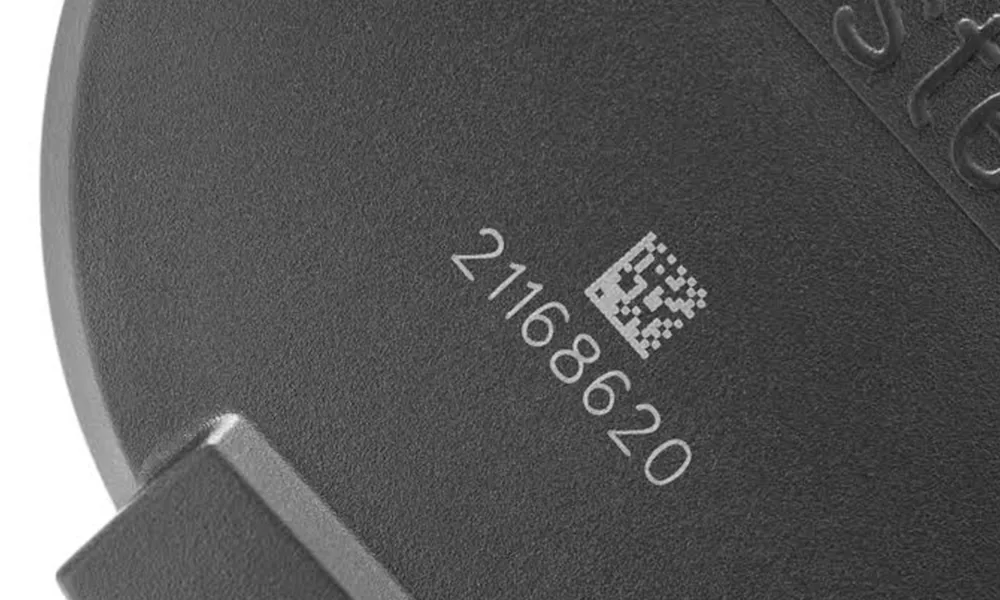
Small Codes Need a Different Acceptance Standard Than a Large Logo
A compact Data Matrix and serial-style mark depend on module edges, contrast and focus consistency. For POM, qualify the smallest production code on the real part instead of approving the process from a larger text mark.
Representative polymer code example. It supports code-design and inspection context but does not prove the result on every POM formulation.
Define the Result Before You Choose the Laser Route
“Can it make a mark?” is not enough. The useful question is whether the actual POM grade can produce the required contrast, code quality and surface condition at a practical production speed.
High-contrast identification
Prioritize easy visual reading, controlled light/dark contrast and limited surface damage.
Machine-readable codes
Prioritize module definition, edge sharpness, stable contrast and repeatable scanner performance on the smallest required code.
Cosmetic marking
Prioritize uniform fill, clean edges, controlled gloss change and minimal discoloration around logos or visible text.
Shallow permanent marking
Use controlled surface modification when identification must remain visible without meaningful material removal or dimensional change.
Texture or engraving effect
If visible depth or texture is acceptable, evaluate the trade-off against roughness, smoke, odor, debris and possible dimensional impact.
Production acceptance
For any target result, define the smallest feature, acceptable appearance, code-readability rule, durability expectation and maximum acceptable cycle time.
How Shape, Wall Thickness and Part Size Change the Marking Plan
POM laser marking is not only a material-response problem. Geometry determines focus stability, access, heat sensitivity, fixture repeatability and whether a standard flat-field setup is enough.
Flat molded parts
Usually the simplest case for maintaining a stable focal plane and uniform mark quality across the required field.
Curved parts and bushings
Curvature can move the surface out of focus. A narrow mark may still fit a flat-field setup, while larger circumferential areas may need rotary handling or another focusing strategy.
Gears and irregular parts
Mark quality may depend as much on repeatable orientation and fixture datums as on laser parameters. Teeth, shoulders and recessed areas can also restrict access.
Thin-wall POM
Use a conservative thermal window because excessive local heat or material removal can create distortion, sink-like appearance or cosmetic damage.
Large parts
Check marking-field size, working distance, part access and whether the workpiece must move between multiple marking positions.
Small precision parts
Fixture repeatability, code size, focus stability and feature resolution become more important as the available marking area decreases.
Machined surfaces
Tool marks, oil, cleaning residue and local stress can change the visible result. Test the final machined and cleaned condition rather than a raw resin coupon.
Assembled components
Confirm access, nearby heat-sensitive parts, loading method and whether the laser can reach the intended surface without creating handling or safety problems.
POM Contrast Depends on Color, Additives and Surface Change
For POM acetal, a readable mark can come from color change, light roughening, controlled surface modification, shallow ablation or additive-assisted darkening. The practical question is not only whether a mark appears, but whether it remains legible without unacceptable odor, edge damage or material weakening.
- Do not transfer black POM parameters to white or natural POM.
- Check alphanumeric text, thin lines and the smallest code module separately.
- Compare center and edge quality across the required marking field.
- Inspect gloss change, whitening, brown edges, roughness and residue under consistent lighting.
| POM condition | Likely marking question | Main risk | What to validate |
|---|---|---|---|
| Black or dark POM | Can fiber or MOPA create a clear light or dark contrast? | Overheating can reduce legibility through ablation, roughness or gloss loss. | Contrast, edge sharpness, code readability and odor at production speed. |
| White or natural POM | Can the mark be made dark enough without additive or masking? | Low absorption can create weak contrast unless energy is pushed into burning. | Darkness, surface damage, residue, repeatability and whether a modified grade is needed. |
| Laser-markable POM-C | Can the specified grade meet small-font or traceability marks? | Assuming one branded grade represents all acetal grades. | Final grade, color, compliance, mark durability and code verification. |
| Filled or lubricated POM | Do glass, PTFE, mineral filler or lubricants change the mark? | Uneven contrast, rough edges, exposed filler or inconsistent batches. | Actual compound, surface finish, wear behavior and fume control. |
| Machined POM parts | Will machining marks, stress or oil affect marking? | Residue, focus variation and inconsistent contrast on cut surfaces. | Cleaning method, surface roughness, fixture repeatability and final inspection. |
Start with the Most Plausible Laser Route, Then Compare Only When Needed
The first test should be chosen from the actual POM grade, color and target result. Dark or laser-additive acetal often gives a clearer reason to start with fiber/MOPA, while light-color or heat-sensitive parts may justify UV screening earlier. Unknown formulations should be treated as sample-test projects rather than source-by-name selections.
Zhuorui Laser can compare fiber and MOPA laser marking machines, UV laser marking machines, green laser marking machines and CO2 laser marking machines when the first route does not meet the required contrast, surface quality or production target.
| POM condition / target | Practical first test | What would trigger another route |
|---|---|---|
| Black or dark POM with identification text | Fiber / MOPA first | Weak contrast, roughness, excessive odor or unacceptable code quality. |
| Laser-markable POM designed for near-infrared response | Fiber / MOPA first | The final grade still fails the required cosmetic or code-readability standard. |
| White or natural POM needing fine dark marking | Consider UV as an early screening route | Use the actual grade to confirm whether UV gives a better balance of contrast, surface quality and cycle time than the initial alternatives. |
| Small code or heat-sensitive cosmetic surface | UV is a practical early screening route | Keep it only if the real part meets the required contrast, edge quality and throughput target. |
| Unknown formulation or uncertain absorption | Compare Fiber/MOPA and UV on the real sample | Use the cleaner, more repeatable route that meets the acceptance criteria. |
| Texture or engraving is acceptable | Evaluate CO2 only where the target effect justifies material removal | Melting, smoke, odor, edge quality or fine-code readability is unacceptable. |
| Selected formulation with a specific absorption advantage | Green may be screened as a conditional route | Do not make it the default without sample evidence. |
Do not keep increasing power when the material response is wrong
If added energy only creates odor, brown edges, roughness or ablation without useful contrast, the next step should be a route, parameter or material review rather than simply using a higher-power machine.

Fiber / MOPA Route
Use this route first when dark, filled or laser-markable POM shows practical near-infrared response. MOPA remains a fiber-laser route and should be selected for pulse-control needs, not simply because it has a different label.
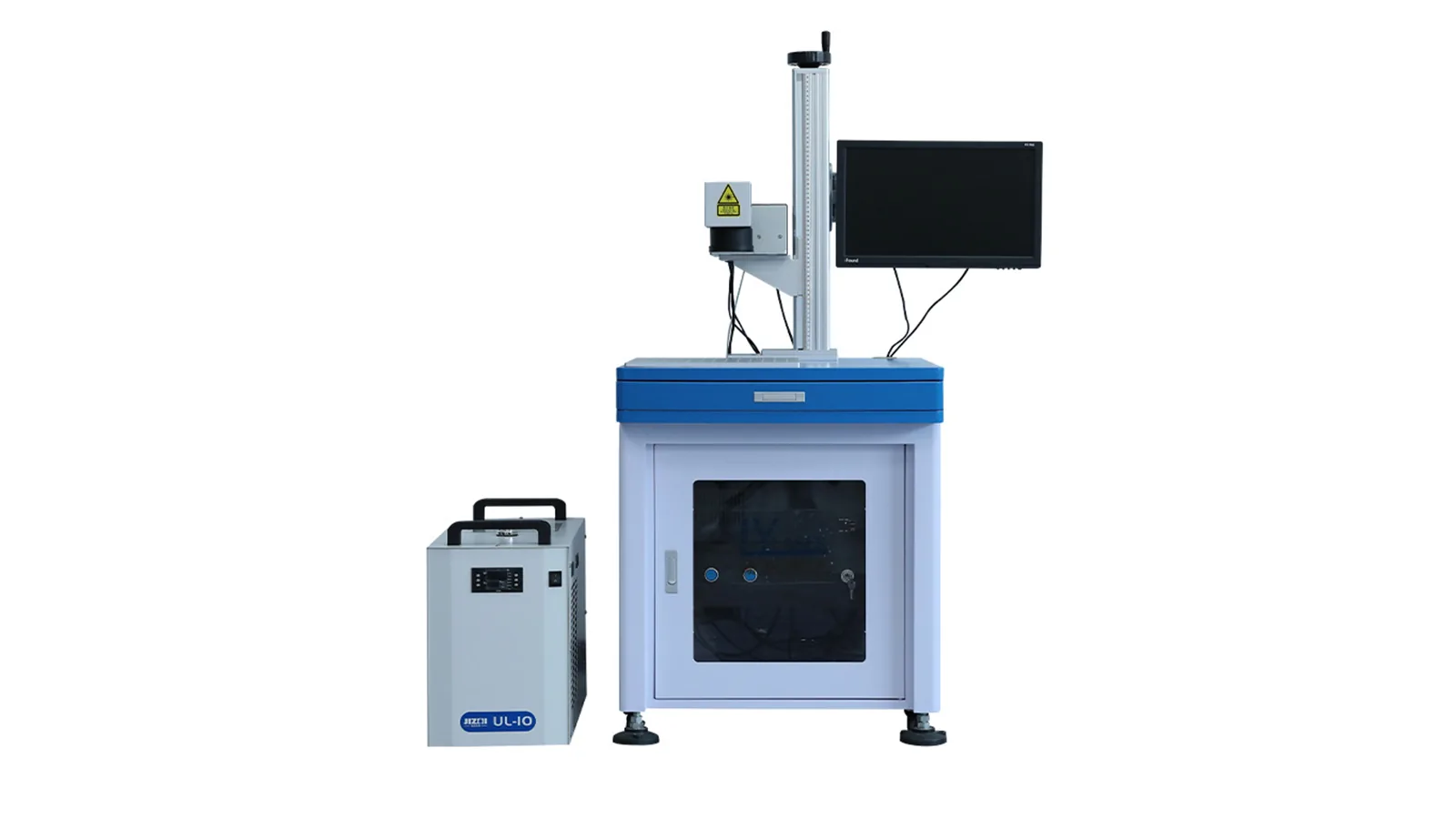
UV Route
Consider UV early for light-color POM, small codes or cosmetic surfaces when the fiber route gives weak contrast or too much thermal effect. Treat this as a screening direction, not a universal rule: final suitability still depends on the actual formulation, production sample and cycle target.
Build a POM Parameter Window, Not a Single Magic Setting
A useful POM trial separates three zones: too little energy, a usable contrast window, and too much thermal decomposition. Zhuorui should record the candidate laser source, lens, power setting, frequency, speed, hatch, passes, focus offset, fixture and extraction condition for every accepted result.
Too Low
Weak or missing mark, poor code readability, low contrast under shop lighting, inconsistent thin lines or no meaningful interaction with the surface.
Usable Window
Readable contrast, controlled edge, limited odor, acceptable surface texture, repeatable result across samples and stable code scan performance.
Too High
Burning, formaldehyde-like odor, heavy smoke, brown edges, ablation, roughness, debris, dimensional change or unacceptable cosmetic damage.
| Variable | Why it matters for POM | Pass/fail signal |
|---|---|---|
| Average power and pulse energy | Controls whether POM reacts enough to mark or overheats into decomposition. | Contrast improves without strong odor, charring or surface collapse. |
| Frequency and pulse width | Changes peak energy and heat distribution, especially for fiber or MOPA screening. | Fine features stay sharp and the mark does not become coarse or low-contrast. |
| Speed and number of passes | Controls dwell time and accumulated heat. | Readability holds at practical cycle time without excessive residue. |
| Hatch spacing and fill angle | Affects filled logos, Data Matrix modules and dense characters. | No closed-cell flooding, missing modules or uneven fill pattern. |
| Focus and field position | POM may have a narrow window on curved or machined parts. | Center and edge marks remain consistent across the marked area. |
| Extraction and airflow | Controls odor, smoke, condensate and operator exposure during repeated marking. | Fume capture works without moving the mark plume across optics or the part. |
What a Failed POM Laser Test Usually Looks Like
A readable mark can still be a poor production result. Weak contrast, burning, roughness, code failure, focus variation and strong decomposition odor are all signs that the current material-process combination needs adjustment.
Safety is part of process qualification
Request the POM grade and SDS before repeated tests, use suitable local extraction and filtration, and review the complete machine enclosure, interlocks, emergency stop and wavelength-specific laser safety measures for the final production layout.
POM Sample-Test Checklist Before Machine Selection
A web page can define the decision logic, but it cannot promise POM contrast, odor or cycle time. Send final acetal samples and acceptance criteria before locking the laser source, optics, extraction and fixture.
| Sample input | What to provide | Why it matters |
|---|---|---|
| POM type | POM-C, POM-H, Delrin-type acetal, laser-markable grade, blend or recycled stream | Different grades and suppliers can shift contrast and thermal response. |
| Color and additives | Natural, white, black or colored POM; fillers, lubricants, glass, PTFE, flame retardants or laser additives | Controls absorption, contrast, odor, surface texture and compliance route. |
| Surface condition | Molded, machined, polished, textured, oily, coated or assembled part | Changes focus, residue, adhesion of contaminants and final appearance. |
| Mark content | Logo, serial number, date code, QR code, Data Matrix, line width and artwork | Defines the spot size, fill strategy, readable contrast and inspection method. |
| Geometry and handling | Flat, cylindrical, gear, bushing, conveyor link, curved part, tray or fixture constraint | Moves the project toward standard marking, rotary, vision, fixture or automation review. |
| Production target | Output, cycle time, loading method, scanner requirement, durability and reject criteria | Connects material feasibility to a realistic equipment configuration. |
| Safety data | SDS, fume constraints, enclosure requirement and extraction environment | Controls safe test preparation and production fume planning. |
Use a production-representative sample
If color, machining, fillers, lubricants, molding condition or another finished-part variable can change the laser response, include that condition in the sample. A clean acetal coupon is useful for screening, but it should not be the final approval sample for a materially different production part.
When Should You Stop and Re-Test?
Stop increasing energy and re-test the process if you see strong odor, brown or burned edges, surface collapse, excessive residue, unacceptable roughness, code-readability failure or unstable results between nominally identical parts. Re-check the laser route, pulse settings, speed, focus, material grade, additives, cleaning condition and extraction instead of treating more power as the default fix.
Use the Accepted POM Sample to Lock the Final Equipment Direction
Once the real part produces an acceptable mark, the test result should be translated into the machine configuration. This avoids choosing power, optics or automation before the material response and production requirement are known.
Laser source and pulse capability
Use the route and parameter window that produced the accepted result. Higher wattage is not automatically a better choice if it narrows the usable thermal window.
Lens and marking field
Match the field to the real marking area, smallest feature, required working distance and part size rather than selecting the largest field by default.
Fixture or rotary
Use part shape, locating datum and repeatability requirement to decide whether a flat fixture, custom nest or rotary axis is needed.
Vision and positioning
Consider vision when part position or orientation varies. Vision helps locate the workpiece, but it does not remove the need to control height and focus.
Extraction and enclosure
Size extraction from the actual fume and odor observed during the accepted test, then review the complete enclosure and safety configuration for the production environment.
Cycle time and automation
Use required parts per hour, loading time, code-data handling, inspection and line interface to decide whether manual loading, fixture indexing, conveyor integration or project-based automation is justified.
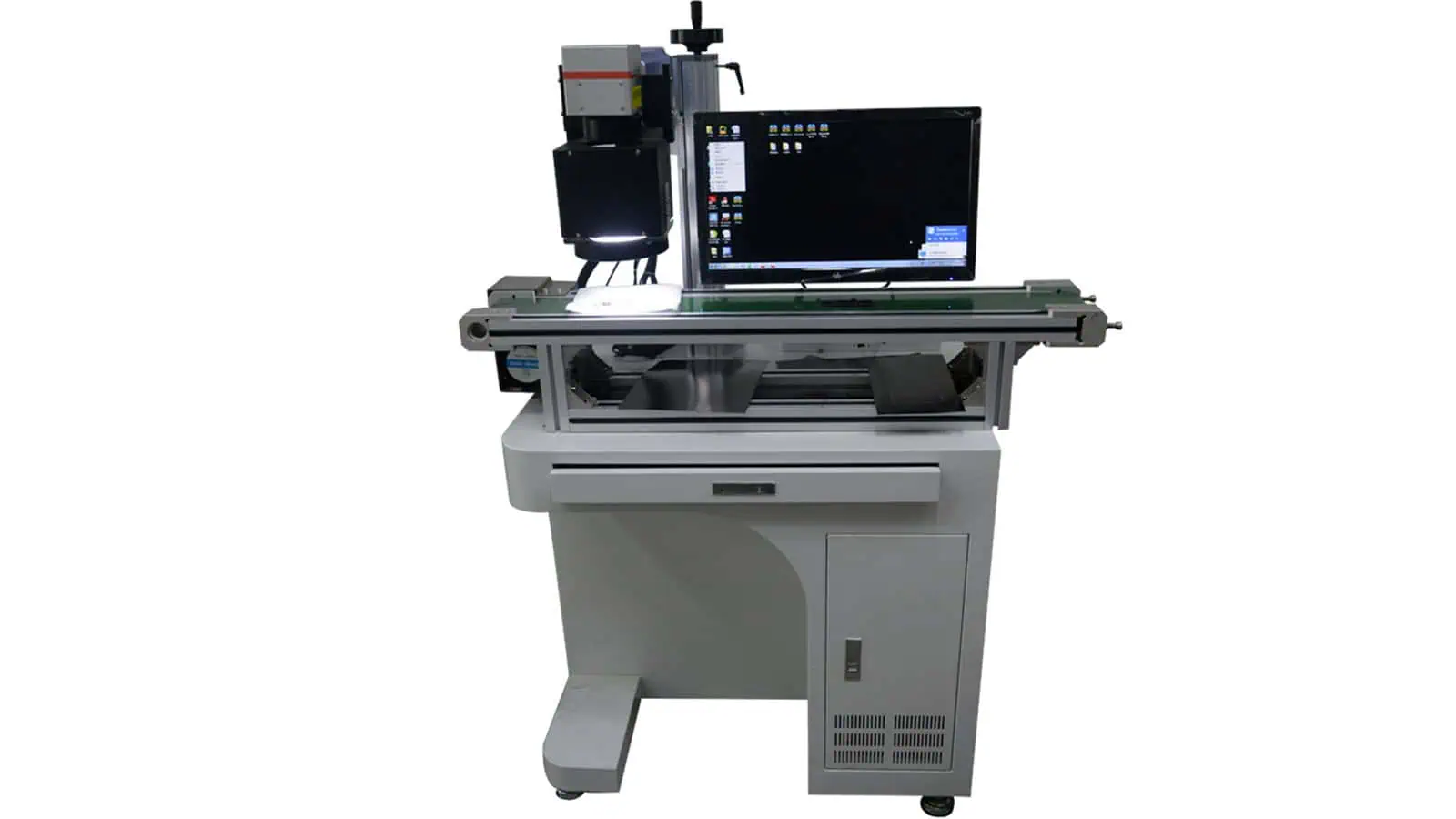
Vision Becomes Relevant When Part Position Varies
If small POM parts arrive with inconsistent position or orientation, a vision-guided marking configuration can reduce manual alignment. It does not replace control of part height, focus or fixture stability when those remain critical.
Equipment configuration example only. Vision is not required for every POM application; it should be selected from the actual loading and positioning problem.
What to send for the final quotation
Send the actual POM part or representative production sample, exact grade and color, artwork or code content, marking area, target appearance, smallest feature, required parts per hour, loading method, inspection requirement, extraction constraints and any rotary, vision, enclosure or automation needs.
Approve the Same POM Condition You Will Actually Produce
After the sample test identifies a workable process, final approval should confirm that the production-representative part still meets the agreed result. Do not restart the whole qualification checklist here—verify only the conditions that can invalidate the earlier test.
Same formulation
Confirm the same POM family, grade, color and relevant additive package.
Same finished condition
Confirm the same molded, machined, cleaned or textured surface condition.
Same acceptance standard
Confirm contrast, smallest critical feature or code, surface quality and repeatability on the production-representative part.
POM Acetal Laser Marking FAQs
Can POM acetal be laser marked?
Yes, POM can be laser marked in selected grades and colors, but it is formulation-sensitive. Black, filled or laser-markable POM may respond better than natural or white POM. Final approval should use the actual production part.
Why is POM contrast difficult?
POM can have low absorption under common near-infrared marking conditions, especially in natural or white grades. Pushing energy too far can create odor, roughness or burning instead of a clean, readable mark.
Which laser is best for POM marking?
There is no universal best source. Fiber or MOPA can be screened for dark or additive-supported POM, while UV, green or CO2 routes may be evaluated depending on color, target effect, heat limit and production speed.
Does POM laser marking create odor?
It can, especially when the process overheats or decomposes the acetal surface. Formaldehyde-like odor, heavy smoke or brown edges should trigger parameter reduction, source review, extraction review or material change.
Do I need a laser-markable POM grade?
Some projects can mark standard POM acceptably, but light-color or high-contrast traceability requirements may benefit from a laser-markable acetal grade or additive route. The material owner should approve any formulation change.
Is this a material page or an industry application page?
This is a material page. It owns POM behavior, contrast, odor and sample testing. Gears, conveyor parts, automotive components, electronics parts and medical workflows should be handled by the relevant application or solution pages.
Send the Actual Acetal Part, Color and Mark Requirement
Include POM-C or POM-H grade, supplier, color, fillers, lubricants, laser-marking additive status, surface condition, drawing or artwork, target contrast, minimum feature size, cycle expectation, odor constraints, extraction environment and SDS. Zhuorui Laser can review the material route and recommend the next sample-test or machine configuration step.
Request a Quote OEM & Custom Inquiry Contact Us