
Cork Laser Marking
Cork charring and pattern marking.
Natural and agglomerated cork can produce a strong dark mark, but granule structure, density, binder and surface finish decide whether a pattern is crisp or spreads into loose char. CO₂ is commonly the first source direction to evaluate; the production grade and target effect still require a representative sample test.
Can cork be laser marked?
Yes—many natural and cork-based surfaces can produce visible darkening, shallow engraving or pattern detail. The qualification is important: cork is a cellular, porous material and a dark mark often includes controlled carbonisation. Density, granule boundaries and binder variation make repeatability a material question, not a wattage question.
Natural cork sheets, agglomerated cork and coated cork can look similar from a distance while responding differently under heat. A low-density sheet may lose edge definition as loose char is lifted from the cells; a dense or sealed surface may hold a fine line but create a darker halo or finish change when the energy is increased. Treat these as qualification conditions to verify on the production cork grade rather than as a fixed result for every cork construction.
The practical decision is not only “will it mark?” It is whether the actual grade can hold the required pattern, contrast, depth and cleanability at an acceptable production duty while smoke and residue are captured safely.
Illustrative comparison only. These swatches are not photographs, tested samples, production evidence or a promise of colour, depth or speed.
Separate cork constructions before comparing results
“Cork” identifies a material family, not one process window. Record the structure, density, binder, backing and finish with every sample so a dark pattern is not mistaken for a universal recipe.
Natural cork sheet
Natural cellular structure can give a warm dark tone and tactile pattern, but pores and density bands may change line width and depth. Compression, moisture and cut direction should be recorded.
Decision: approve the pattern across open and dense areas rather than only on the smoothest section.
Agglomerated cork
Granules are bonded into a sheet, block or shape. Granule size, compression and binder distribution can create small dark/light islands, loose char or a different edge response.
Decision: test the exact granule grade and binder system; do not infer behaviour from natural cork.
Cork-rubber or composite
Rubber, polymer, textile or mineral additions may melt, gloss, smoke or leave residue before the cork structure is reached. The word “cork” does not identify the full composition.
Decision: obtain the composition or SDS before testing unknown composite material.
Coated or printed cork
Sealants, lacquer, ink, foil, laminate or a decorative top layer may absorb first. Removal can reveal a different colour or expose pores, while repeated heat may change gloss.
Decision: define whether the target is surface colour change, coating removal or shallow engraving.
Where is cork laser marking commonly used?
Cork is marked for branding, decoration, identification and personalization across products that range from flat sheets to small cylindrical closures. The application changes the artwork, fixture, marking area and acceptance criteria, but the material response still has to be qualified on the actual cork construction.
Closures and cork stoppers
Wine, beverage and specialty closures may carry logos, origin marks, decorative graphics, batch identifiers or custom branding. Curvature and compression matter because the mark must remain consistent around a small cylindrical surface.
Coasters, placemats and lifestyle goods
These products often use logos, names, decorative patterns or personalization. Cosmetic consistency, edge quality and cleanability usually matter more than engraving depth.
Sheets, panels and cork fabric
Flat sheet, decorative panel and cork-textile products may use branding, layout marks, graphic patterns or product identification. Large areas bring marking-field, flatness and handling questions into the machine decision.
Cork-rubber and industrial composites
Gaskets, seals or composite parts may need part numbers, batch data or simple identifiers. Because binders, rubber or other additives can dominate the surface response, the full composition should be confirmed before process approval.
Why use a laser? A laser can create branding, identification or decorative contrast without adding a label or ink layer. Whether that advantage is useful depends on the required appearance, durability, readability, production rate and the way the cork surface responds to heat.
What is usually marked on cork?
The artwork determines how demanding the process really is. A bold logo can remain attractive across natural granule variation, while small text or machine-readable codes need tighter edge definition and a more controlled surface.
Logos and brand marks
Common on closures, coasters, gift products, accessories and decorative panels. Review line width, filled areas, halo and the way natural grain changes the visual tone.
Names and personalization
Useful for custom gifts and short-run products. Check the smallest font, spacing and whether repeated names remain readable across normal material variation.
Part, batch and date information
Industrial or packaged products may need lot numbers, dates, SKU information or simple identifiers. The acceptance target should define readability after the normal cleaning and handling steps.
Symbols and instructions
Simple icons or handling symbols usually tolerate more texture than small characters, but the mark still needs enough contrast and edge definition to be recognized reliably.
QR and Data Matrix codes
Possible on suitable cork surfaces, but visible contrast alone is not enough. Coarse granules, open pores and fuzzy edges can disturb cell geometry, so the real code size and verification method should be included in the sample test.
Decorative patterns
Fine graphics can emphasize the natural cork texture, but dense fills, repeated passes and very small details may increase char, smoke and edge spread.
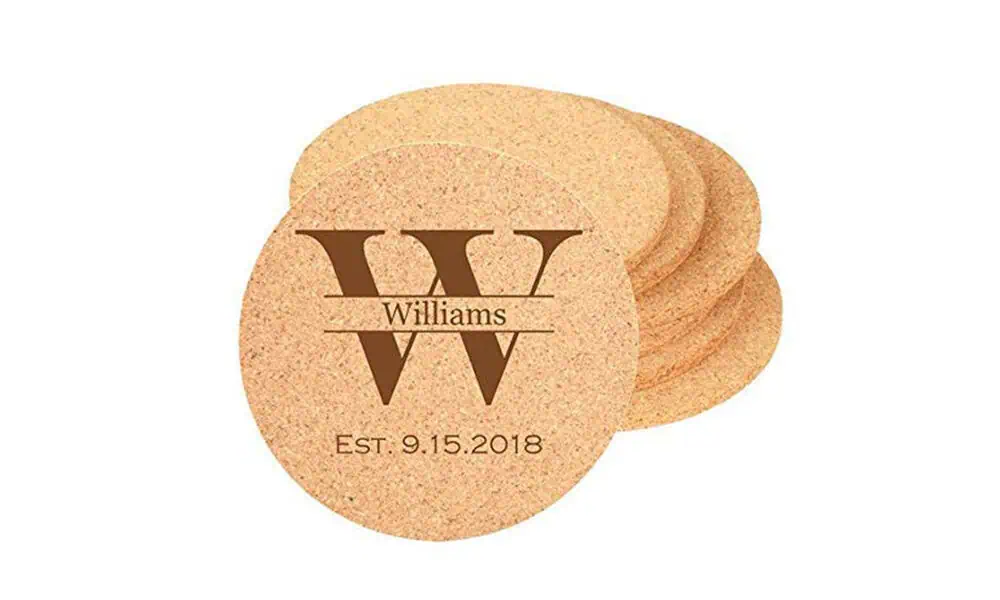
This cork-coaster example shows the kind of dark branding and personalization users often want from cork marking. Treat it as an application example rather than a universal result: grain, density, binder and finish still need to be validated on the production cork.
What cork marking result are you trying to achieve?
The correct process depends on the result you need. Surface darkening, shallow engraving, coating removal and small-code marking place different demands on contrast, depth, heat input and edge control. More energy can deepen a mark, but it can also widen lines, lift loose char, change binder gloss and increase smoke.
Prioritize contrast with limited char
Use controlled thermal darkening when the goal is a visible mark with little depth. Judge contrast, halo, loose char and cleanability across normal grain variation.
Prioritize depth without losing the edge
Material removal can create tactile depth, but deeper settings increase dust, smoke, edge breakup and heat accumulation. Depth and graphic quality should be approved together.
Prioritize clean layer removal without damaging the cork
When a sealant, print, lacquer or decorative top layer is the target, check whether it can be removed or altered without excessive charring, pore damage or unwanted gloss change in the cork underneath.
Prioritize readable features and stable geometry
Small text, symbols and 2D codes need stable line width and feature geometry. Coarse granules, pores and fuzzy char can become the limiting factor before contrast does.
Common Cork Laser Marking Risks and Failure Modes
| Visible symptom | Possible material or process cause | First review direction |
|---|---|---|
| Pattern looks pale in some granules | Density, binder or cell structure changes absorption across the same artwork | Compare the pattern across normal material variation before adding energy. |
| Edges look wide or fuzzy | Accumulated heat, defocus, smoke deposition or loose cells at the line edge | Review focus, speed, spacing, pass count and smoke capture together. |
| Loose black residue remains | Excess carbonisation, fragile surface or condensed smoke | Add the real cleaning step to acceptance and capture the plume close to the mark. |
| Coating bubbles or changes gloss | Finish response differs from the cork substrate | Identify the surface stack and test removal or discoloration as a separate target. |
| Deep result loses pattern detail | Material removal is dominating fine-line control or the granule structure is breaking | Separate the depth target from the graphic target and retest. |
How do shape, thickness and size change the marking plan?
The cork grade determines how the surface reacts, while the part geometry determines how consistently the laser can stay in focus and how the workpiece should be held, rotated or repositioned. A flat coaster and a cylindrical stopper can use the same material family but need different handling.
Flat sheets and coasters
Flat parts are usually the simplest geometry because the working surface can stay close to one focal plane. Check sheet flatness, thickness variation, support and the marking area.
Configuration effect: field size and fixture/support become more important as the part or graphic gets larger.
Cork stoppers and cylindrical parts
Curvature changes the distance from the marking head across the artwork. A wide graphic can lose focus or distort if it is treated like a flat surface.
Configuration effect: evaluate a rotary fixture, controlled part rotation or another geometry strategy when the mark extends around the circumference.
Thick blocks and deeper engraving
For surface darkening, overall thickness may be less important than surface condition. For deeper engraving, heat accumulation, material removal, dust and depth consistency become stronger constraints.
Configuration effect: approve the required depth separately from cosmetic edge quality before selecting a production setting.
Soft or compressible cork
Clamping pressure can compress the surface and change local height or density. That can move the workpiece relative to focus and alter line width or repeatability.
Configuration effect: use a fixture that locates the part without excessive compression and include normal dimensional variation in the test set.
Large sheets, panels or roll material
Large-format work can exceed a single marking field and introduce flatness, repositioning, registration or web-handling issues.
Configuration effect: evaluate field size, repositioning accuracy, conveyor or roll handling, and whether the intended artwork can be completed without visible stitching.
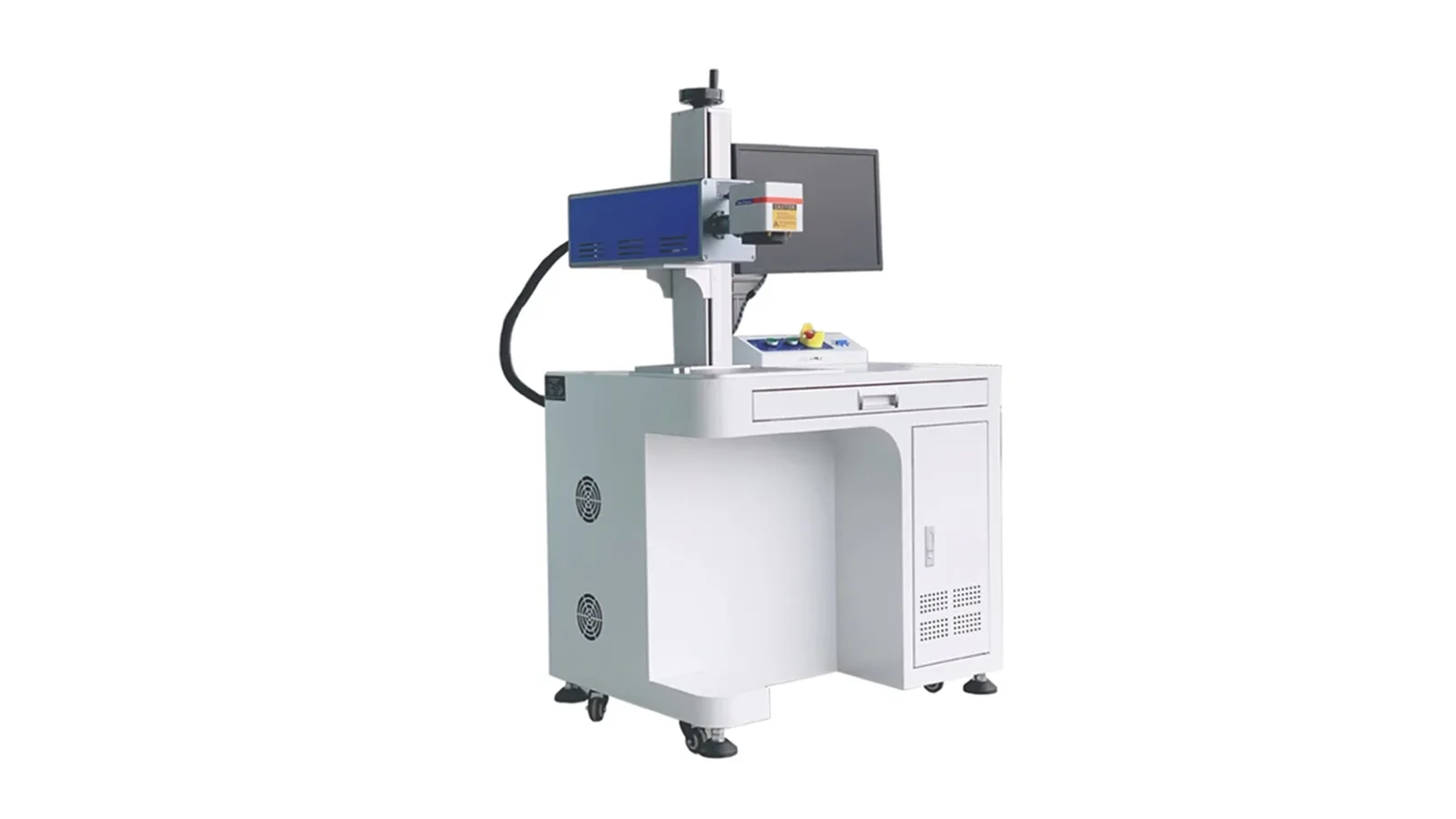
CO₂ machine-family example for the first test route. Field size, focus, enclosure, extraction and handling should be configured after the cork sample result is accepted.
A conditional source screen
Use this sequence to organize the sample test and configuration review; the final process window still comes from the representative production material.
CO₂ is the usual first technology to evaluate for cork
Many natural and cork-based organic surfaces absorb CO₂ laser energy well enough for surface darkening, shallow engraving and pattern trials. That is why a CO₂ laser marking machine is a sensible first direction for cork qualification. It does not make every CO₂ system interchangeable.
Actual wavelength, source design, beam delivery, marking field, focus, duty cycle, enclosure and extraction must fit the grade and the desired mark. Average machine wattage alone cannot predict edge quality or smoke load; repeated passes and deep patterns can change both.
Move to product selection after the cork test is defined. Compare available CO₂ laser marking machine configurations after the cork sample test has established the required field, focus, handling and extraction conditions. Fiber or UV may deserve a controlled comparison for a special coating or heat-sensitive detail, but only when a representative sample supports it.
Extraction is part of cork marking quality
Smoke capture affects contrast, optics cleanliness, odour, residue and the working environment. Cork is combustible, and a binder or coating can change the fume profile; extraction should be reviewed with the material and production duty rather than added later.
Identify what is being heated
Record natural or agglomerated structure, granule size, binder, rubber/polymer content, ink, sealant, laminate and cleaning agent. Unknown coatings and composite binders should not be treated as ordinary cork; obtain supplier documentation or SDS where applicable.
Capture smoke close to the pattern
Airflow, hood position and filtration must suit the marking field and smoke volume without disturbing the process. Poor capture can redeposit char and make a pattern appear less repeatable than it is.
Include fire and housekeeping controls
Address active observation, hot or smoldering residue, loose cork dust, filter maintenance and safe handling after the laser stops. The final safety design depends on the complete machine and workplace risk assessment.
Validate at production duty
A short coupon may not represent odour, filter loading or residue during a long batch. Repeat the test at realistic duty and include cleaning, extraction and filter checks in the review.
What Should You Provide for a Cork Sample Test?
The fastest useful test begins with production material and a measurable acceptance target. A generic cork swatch cannot reveal density, binder, finish or the normal range that the pattern must tolerate.
Material identity
Natural sheet, agglomerate, cork-rubber or composite; supplier, grade, thickness, density and binder.
Surface condition
Raw, sanded, sealed, printed, laminated, foil-faced, waterproofed or cleaned surface.
Mark requirement
Pattern or code artwork, smallest feature, field size, preferred tone, depth, touch and allowed halo.
Variation set
Samples that include normal granule changes, density bands, joints, edges and production batches.
Production context
Part size, flatness, loading method, quantity, target cycle, cleaning, extraction and inspection method.
Acceptance check
Agree how contrast, line width, depth, residue, odour, readability and repeatability will be judged.
How does an accepted cork sample become a machine configuration?
Machine selection should follow the accepted material result, not precede it. Once the real cork grade can produce the required mark, the remaining decisions convert that result into a repeatable production setup.
Confirm the laser route
Keep CO₂ as the default direction when the sample supports it. Compare another route only when the surface stack, heat sensitivity or required detail gives a specific reason to do so.
Set the marking field and focus strategy
Use the part size, artwork size, smallest feature and allowable distortion to select the field and focus arrangement. Larger fields and curved workpieces should be checked against the required detail rather than chosen for size alone.
Choose the fixture or handling method
Flat sheets may only need support and repeatable location. Stoppers can require rotary handling; soft parts need low-compression fixtures; large sheets or rolls may need repositioning, conveyor or web handling.
Size extraction for the real duty
Smoke, odour, binder content, mark depth and batch length determine the extraction and filtration requirement. A short coupon test should not be used to size a production fume-control system by itself.
Verify throughput without losing the accepted result
Check that the selected setting still meets contrast, edge, residue, readability and cleaning requirements at the intended batch length and loading method. Scan speed alone is not the full production cycle.
Finalize the quotation inputs
For a useful quotation, provide the accepted sample result or target, cork construction and finish, part dimensions, marking field, artwork, quantity or cycle target, handling requirement, extraction needs and any enclosure or integration constraints.
Cork laser marking FAQ
These answers define a safe starting direction. Final tone, depth, speed, residue and extraction still depend on the actual construction and finish.
Can a CO₂ laser mark natural cork?
Many natural cork grades can be evaluated with CO₂ for darkening, pattern marking or shallow engraving. Density, moisture, target effect and extraction determine the useful process window, so production material should be sampled before choosing a configuration.
Why does one cork pattern look darker than another?
Cell density, granule boundaries, binder, compression and moisture change absorption and heat flow. Compare the natural variation first; increasing energy can widen the pattern or create extra char.
Can one setting mark every agglomerated cork?
No. Granule size, binder chemistry, density and surface coating vary widely. Keep an accepted parameter record for each material and finish variant.
Does coated or printed cork need a separate test?
Yes. A sealant, ink, foil or laminate may respond before the cork substrate. Decide whether the target is colour change, coating removal or engraving, then test the full surface stack.
Do cork marking trials need fume extraction?
Plan extraction for smoke and odour, especially with binders, rubber/polymer additions, coatings or high-volume work. Required airflow and filtration depend on the material and machine; review the complete setup and SDS where applicable.
Does this page cover cork cutting and perforation?
No. This page covers material response to marking, shallow engraving and surface effects. Cutting and perforation require a separate process, safety and application review.
Send the real cork grade, finish and pattern target
Zhuorui Laser can review the structure, density, binder, surface stack, marking field, contrast or depth goal, expected throughput, extraction need and machine configuration before a quotation is finalized.