Jewelry Application Guidance
Laser Marking for Gold, Silver & Precious Metal Jewelry
A practical jewelry marking setup starts with the actual piece. Geometry, surface finish, mark content, fixture or rotary needs and real-sample validation all influence the final configuration for gold, silver and other precious metals.
Application Scope
What Determines a Jewelry Laser Marking Setup
The right setup starts with the actual jewelry piece: its shape, surface finish, mark location, required result and production method.
A polished ring, a flat pendant and a textured bangle can create very different access, focus and workholding conditions even when the base material is similar.
For rings, pendants, charms, bracelets, bangles and other small jewelry pieces, the machine decision should be made together with fixture or rotary needs and sample validation.
Marking Tasks
Common Laser Marking Tasks for Precious Metal Jewelry
The same machine category can produce very different results depending on mark size, purpose and acceptable surface effect.
Logos and Maker Marks
Small brand symbols, maker marks and workshop identifiers need readable detail, controlled placement and sample confirmation on the actual surface finish.
Names and Dates
Personalized text, dates and initials require artwork control, consistent positioning and efficient changeover for small batches.
Hallmark-Style Content
A laser can create readable symbols or text for hallmark-style content when testing confirms the result. Legal hallmarking approval is a separate requirement.
Decorative Patterns
Fine linework, simple patterns and micro details need careful focus, field size and test confirmation on the actual finish.
Geometry & Holding
Geometry Decides the Workholding Strategy
Flat jewelry pieces, curved rings and larger bangles do not create the same fixture or focus problem.
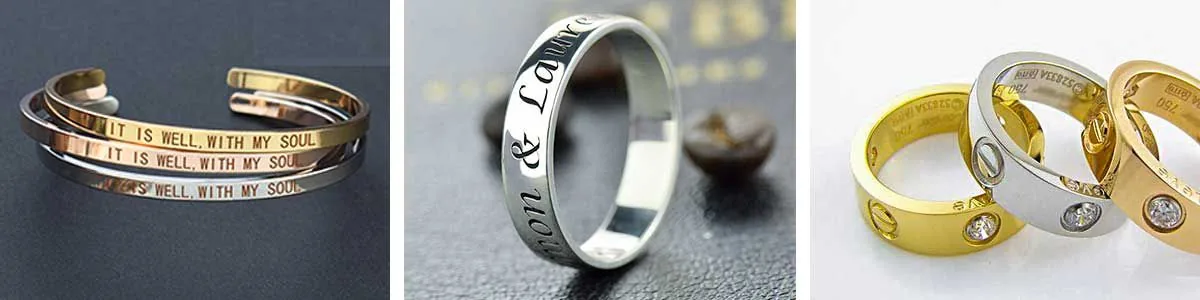
Flat charms and pendants can often be evaluated with a flat-field marking setup and a small positioning fixture. Ring outside marking may require a rotary axis if the mark must follow the circumference or remain consistent around the curved surface.
Ring inside marking requires more careful access, focus control, fixture design and sample testing. Bracelets and bangles introduce larger diameter variation, curved surfaces and clamping limitations.
- Flat pieces: confirm mark area, field size and locating method.
- Ring outside: evaluate rotary alignment, diameter range and mark angle.
- Ring inside: confirm access, focus and holding stability before quotation.
- Small loose parts: use nests, trays or repeatable fixtures for batch consistency.
Material & Surface Finish
How Material and Surface Finish Affect Jewelry Laser Marking
Polished, brushed, plated, coated, oxidized or textured surfaces can respond differently under the same laser platform.
Jewelry Workpiece Factors
Start with jewelry shape, mark position, production task, fixture or rotary needs, workflow and RFQ inputs.
Gold Laser Marking
Use the gold material guide for alloy, surface-condition and gold-specific response considerations that need sample confirmation.
Silver Laser Marking
Use the silver material guide for silver-specific response, surface-condition and sample-testing considerations.
Machine Configuration
Choosing a Laser Configuration for Jewelry Marking
Do not select by power alone. The configuration should come from material, finish, part geometry, mark content and workflow.
For many precious-metal jewelry marking tasks, a fiber laser marking platform is the first practical evaluation direction. Q-switched fiber and MOPA fiber configurations may both be relevant depending on the mark target and selected product configuration.
MOPA is not automatically required. Its pulse-width control is worth evaluating when the target involves contrast, heat input or a particular surface effect. Desktop, split-type, cabinet or enclosed layouts should be selected from workspace, safety, batch workflow and OEM/distributor requirements. For inside-ring marking or curved jewelry, the fixture and rotary decision should be made from the actual piece diameter and access path, not from machine power alone.
- Rotary axis for ring or circumferential work when geometry requires it.
- Small fixtures or nests for repeated positioning across batches.
- Possible vision support when random placement or fine positioning becomes a real workflow requirement.
- Extraction and enclosure requirements should be reviewed as part of the complete system and intended operating environment.
Validation
Sample Testing Before Final Quotation
Representative samples are the most reliable way to confirm how the actual alloy, finish, geometry and mark design respond before the configuration is locked.
| Validation Input | Why It Matters | What Can Be Confirmed |
|---|---|---|
| Actual jewelry samples | Alloy, finish and geometry change the marking result. | Initial process direction and visible surface response. |
| Real mark artwork or text | Stroke width and size affect readability. | Practical mark size, field placement and artwork adjustment needs. |
| Target location | Flat, outside curve and inside-ring areas need different access. | Fixture, rotary and focus feasibility. |
| Acceptance criteria | Decorative marks, identifiers and traceability marks are judged differently. | Whether the tested output is acceptable for the buyer’s workflow. |
RFQ Preparation
What to Send Before Zhuorui Configures the Solution
Clear input reduces configuration ambiguity and helps determine whether a standard machine, rotary setup or OEM package should be evaluated. For jewelry work, the deciding variables are piece geometry, surface finish, mark location and the exact acceptance target on the finished article.
Workpiece
Jewelry type, dimensions, material, surface finish, curvature and whether the mark is on a flat area, outside curve, inside ring, edge or sidewall.
Mark Content
Logo, text, name, date, hallmark-style symbol, serial number, QR/data mark or decorative pattern, with artwork and target mark size.
Production Mode
One-off personalization, small batch, repeated batch, distributor package, private-label equipment or OEM/ODM configuration request.
Holding Method
Whether the part may need a nest, clamp, rotary axis, custom fixture, positioning aid or possible vision support.
Acceptance Standard
Readable, decorative, low surface change, repeated placement, handling resistance or downstream cleaning condition relevant to the buyer.
Commercial Route
Standard quote, distributor supply, OEM/private-label support, or custom configuration through Zhuorui’s engineering review.
FAQ
Jewelry Laser Marking FAQ
Can a laser mark gold and silver jewelry?
Yes, many gold and silver jewelry marking tasks can be evaluated with a fiber laser marking system. The exact result depends on alloy, finish, geometry, mark size and sample testing.
Is MOPA required for jewelry marking?
Not always. MOPA fiber is worth evaluating when pulse-width flexibility is useful, but it is not automatically required for every jewelry job.
Can the machine mark inside a ring?
It may be possible with suitable fixture or rotary support, but inside-ring marking must be tested for access, focus, field size and holding stability.
Can laser marking replace legal hallmarking approval?
No. Laser marking can produce readable hallmark-style content, but legal hallmarking approval is separate from the marking process itself.
Can Zhuorui guarantee no visible effect on polished jewelry?
Not before sample testing. Polished and plated surfaces can respond differently, so the actual piece should be tested before confirming a low-surface-change result.
What should I send for sample testing?
Send representative jewelry pieces, the real mark artwork or text, target position, required mark size and acceptance criteria.
Configuration Review
Prepare a Jewelry Sample and Marking Requirement
Zhuorui can evaluate the laser source direction, machine structure, fixture or rotary needs and OEM/private-label options after reviewing the actual jewelry piece, finish and mark content.