
PP Material Feasibility
Polypropylene Laser Marking
Polypropylene is a formulation-sensitive plastic. Unmodified PP may show weak contrast under common 1064 nm near-infrared fiber marking, while pigments, fillers, laser-sensitive masterbatch, surface texture and molded condition can change the result. Use this page to qualify the PP material first, then route the project to the right machine and application workflow.
Request a PP Sample Test OEM & Custom InquiryQuick Answer
Can Polypropylene Be Laser Marked?
Yes. Polypropylene can be laser marked, but the result is formulation-sensitive. The practical question is not simply whether a part is labeled “PP”; it is whether the actual resin grade, pigment, filler and additive package can produce the required contrast or surface change without unacceptable melting, gloss change, distortion or residue.
Natural, white and lightly pigmented PP often need more careful source screening, and some production projects use a laser-sensitive additive or masterbatch to create a wider and more repeatable marking window. Final source selection should be based on the production material, final color and molded surface.
Do not buy the laser from the polymer name alone. Qualify the final PP formulation first, then choose the source and machine configuration around the accepted sample result.
Polypropylene Variables
Compound, Color and Surface Change the Result
Treat each PP grade and color as a separate qualification case. Resin supplier, masterbatch, filler loading and mold texture can move the process window even when the drawing is unchanged.
| Input | What to ask for | Why it matters |
|---|---|---|
| PP grade | Homopolymer, random copolymer, impact copolymer, melt-flow data and supplier grade | Mechanical grade and crystallinity can change heat response and surface behavior |
| Color system | Natural, white, black, gray, colored masterbatch or painted/coated surface | Pigments can help or reduce absorption and affect final contrast |
| Additives | Laser marking additive, talc, calcium carbonate, glass fiber, flame retardant, UV stabilizer and recycled content | Additives can create the absorption path, but can also introduce burn, haze or residue risk |
| Part condition | Mold texture, gloss, gate area, wall thickness, stress and post-treatment | Final molded surfaces may mark differently from flat test plaques |
| Acceptance criteria | Logo, serial number, Data Matrix, QR code, contrast, minimum stroke and durability test | Machine selection should be based on the required mark, not only whether a visible mark appears |
PP Applications
Where Polypropylene Parts Are Marked — and Why
PP is widely used where low weight, chemical resistance, moldability and cost matter. Laser marking is typically added when the product needs permanent identification, traceability, machine-readable codes or branding without labels or ink.
Automotive & EV PP Parts
Interior trim, clips, housings and molded components may need part numbers, supplier identification, cavity information or traceability codes that remain readable through handling and service.
Caps, Closures & Packaging
Caps, closures and PP packaging parts may need lot codes, date codes, product identifiers or machine-readable codes. Here, line speed and consistent code contrast can matter as much as appearance.
Consumer & Household Products
Buttons, housings, fittings and molded consumer parts commonly use laser marking for logos, model information, symbols and durable product identification without consumable ink.
Mark Content
What Is Usually Marked on PP?
The mark content determines feature size, contrast requirement, inspection method and often the acceptable cycle time. A visible logo and a production Data Matrix are not the same laser-marking task.
Identification & Traceability
Part numbers, serial numbers, lot or batch codes, date codes, cavity IDs and supplier identifiers used to connect a molded PP part to production records.
Machine-Readable Codes
Data Matrix, QR codes and 1D barcodes require controlled cell size, edge definition, contrast and scan verification on the real molded surface.
Branding & Product Information
Logos, model numbers, symbols, ratings and user-facing product information typically prioritize appearance, repeatability and resistance to rubbing or cleaning.
Production & Assembly Marks
Assembly references, inspection marks, orientation symbols and internal component IDs may favor speed and readability over a highly cosmetic finish.
Desired Marking Result
Define the PP Mark You Need Before Choosing the Laser
“Laser markable” is not a complete acceptance criterion. The required result may be dark contrast, light contrast, a cosmetic color change or a code that must remain machine-readable after handling and service exposure.
Dark Contrast Mark
Often requested on natural, white or colored PP. The achievable darkness depends strongly on pigment, fillers and whether the compound includes a laser-sensitive additive.
Light / Gray Contrast
Common on darker PP formulations where the laser produces a lighter visible change. Check uniformity, haze and whether the mark remains legible after abrasion.
Cosmetic Surface Mark
Logos and user-facing text may require tight control of gloss change, melting, edge swelling, discoloration and texture so the mark fits the molded surface appearance.
Verified Readable Code
For Data Matrix, QR or barcode work, success means reliable scanning at the required cell size and production speed — not merely that the code is visible to the eye.
Part Geometry & Size
Wall Thickness, Curvature and Molded Features Change the Process Window
PP parts are often thin-wall, curved or highly textured. Geometry affects heat sensitivity, focus, fixture design and whether one fixed marking field can hold the required quality across the entire mark.
Thin-Wall Moldings
Thin sections can show local softening, sink-like distortion, gloss change or deformation sooner than thicker sections. Validate the energy window on the finished wall thickness.
Curved Caps & Housings
Curvature changes focal distance across the mark. Small curved areas may work with a controlled fixture and field size; larger height variation may require dynamic focus or another positioning strategy.
Texture, Gates & Weld Lines
Mold texture, gate regions, ribs, weld lines and local stress can change appearance and contrast across one part. The final mark location should be tested, not inferred from a flat plaque.
Large Parts or Multi-Part Fixtures
Part size and nesting determine marking field, lens choice, fixture repeatability and whether XY motion, vision alignment or conveyor handling is more practical than a single fixed field.
Laser Route Screening
Choose a PP Test Route by Material Response, Not by Habit
A fiber laser can be practical on some additive-assisted PP parts, while UV may reduce visible heat effects on sensitive surfaces. CO2 may be useful for surface texturing or coating removal on some plastic systems. The final choice should be proven through samples, not selected from polymer name alone.
Fiber / MOPA route
Good first screening route when PP contains laser-sensitive additives, dark pigments or a compound designed for 1064 nm near-infrared absorption. Verify contrast, edge swelling and heat marks.
UV route
Useful when the PP part is heat-sensitive, cosmetic or requires small readable codes. Confirm cycle time, contrast and any surface haze or brittleness on final molded parts.
Green route
A conditional screening option for some plastics when UV and fiber do not provide the desired balance. Use this route only when actual PP sample testing confirms the required result.
CO2 route
May be relevant for surface ablation, texture, coating removal or larger marks on certain plastic systems. Watch melting, residue, edge quality and extraction requirements.
Vision / fixture route
Needed when PP parts are small, molded in trays, randomly oriented or require precise code placement. The material result and positioning workflow should be tested together.
Flying / online route
For caps, closures, films or molded parts on a line, validate PP contrast at the required speed before locking the conveyor, encoder, sensor and extraction plan.
| Laser route | Why test it | Main boundary |
|---|---|---|
| 1064 nm fiber / MOPA | Often practical when PP uses laser-sensitive additives, dark pigment or an NIR-absorbing masterbatch | Unmodified PP can show weak contrast, melting or a narrow process window |
| 355 nm UV | Useful candidate for small codes, cosmetic surfaces and heat-sensitive molded parts | Contrast and cycle time still require testing on the final PP compound |
| 532 nm green | Conditional option when fiber and UV do not balance contrast, heat and appearance | Use only when actual PP sample testing confirms the required result |
| CO2 | May fit surface texturing, coating removal or larger non-cosmetic marks on some plastic systems | Melting, residue, edge quality and extraction must be checked |
Additive-Assisted Marking
Laser-Sensitive Additives May Be the Practical PP Path
PP can be less responsive to common near-infrared laser marking than some other polymers. In production, a practical route may be to use a PP compound or masterbatch designed for laser marking, then tune the source and parameters to the required contrast, surface quality and durability.
Additives are not a machine-only decision. They can affect color, mechanical properties, compliance, recyclability, cost and customer approval. Zhuorui Laser can test the marking response, while the material owner should approve the final compound for the end product.
| Control item | Without laser-marking additive | With laser-marking additive / masterbatch | What must stay the same |
|---|---|---|---|
| Material identity | Use the production PP grade as the baseline. | Use the same PP base grade with only the approved laser-marking additive or masterbatch change. | Supplier grade, color target, molded texture, wall thickness and part geometry should be matched as closely as possible. |
| Marking response | Contrast may be weak or the usable process window may be narrow, depending on pigment, filler and resin formulation. | The additive is intended to improve laser energy absorption or visible color change, but the achieved result still depends on formulation and laser settings. | Use the same laser source, wavelength, lens, focus, artwork, code size and evaluation method for the A/B comparison. |
| Quality checks | Record contrast, melting, gloss change, edge swelling, residue and code readability. | Record the same items and check whether improved contrast introduces haze, brittleness, color shift or other side effects. | Apply the same acceptance criteria and durability test to both samples. |
| Decision | Keep the baseline formulation if it already meets the required mark quality and durability. | Use the additive-assisted route only when the improvement is repeatable and the material owner approves the resulting formulation. | Document resin grade, additive identity/loading where available, sample photos and the validated laser parameter window. |
Risks & Failure Modes
Common Reasons a PP Mark Fails Qualification
A mark can look acceptable in one photo and still fail in production. Separate contrast problems, thermal damage, code quality, formulation variation and fume-control requirements before freezing the machine configuration.
Weak or Inconsistent Contrast
Natural or lightly pigmented PP may absorb too little energy for a stable visible change. Resin, pigment or additive variation can also make one batch mark differently from another.
Melting, Gloss Change or Edge Swelling
Too much local energy can soften the surface, round small characters, change gloss or distort thin-wall regions. Reduce the process window to what the final molded part can tolerate.
Haze, Brittleness or Color Shift
A formulation or setting that improves contrast can still create an unacceptable cosmetic or surface-integrity change. Compare the accepted result against the actual product specification.
Poor Code Readability
Small Data Matrix or QR codes can fail when cells merge, edges soften, contrast varies across texture or curvature, or the code sits outside a stable focal range. Validate with the intended scanner.
Material or Batch Change
A supplier change, recycled-content shift, masterbatch change or revised additive loading can move the marking window. Re-test when the formulation changes materially.
Fumes, Residue & Laser Safety
Review the PP grade, SDS, pigments, fillers, flame retardants, recycled content and any coating or ink. Production trials may require local extraction, filtration and an enclosure/interlock strategy appropriate to the selected laser source.
Sample Qualification
How to Prepare a Useful PP Laser Marking Test
The fastest way to avoid a wrong equipment choice is to send production PP samples and define the pass/fail criteria before quoting a machine. If the final resin is not fixed yet, test multiple PP compounds side by side.
Identify the PP
Grade, supplier, color, additive package, SDS and final-material status → safe test route and whether additive-assisted marking is likely required.
Define the Mark
Artwork, code size, line width, contrast target, scan-read requirement and surface-damage limit → cosmetic, traceability, coding or functional-marking acceptance criteria.
Screen Laser Sources
Candidate 355 nm UV, 1064 nm fiber/MOPA, 532 nm green or CO2 trials → shortlist of source type, power range, lens and usable parameter window.
Check Production Fit
Part geometry, fixture, cycle time, batch size, orientation, extraction and automation requirements → workstation, vision, fixture, rotary or line-solution direction.
Document the Result
Photos, parameter notes, code readability, durability result and rejected conditions → machine recommendation with the validated process window and known limits recorded.
Machine Selection
Match the PP Result to the Equipment Configuration
After sample testing, Zhuorui can match the laser source, galvo, field lens, enclosure, fixture, rotary, vision, extraction and optional automation. The equipment configuration should follow the validated PP response rather than the polymer name alone.
For small PP parts, cosmetic surfaces or repeated part loading, include fixture and inspection planning early. For line marking, test PP contrast at the real speed and focal condition before defining the online equipment.
Evidence & Specification Check
What Counts as Reliable Evidence for a PP Marking Decision?
A plastic photo alone does not prove that a specific polypropylene grade will mark the same way. Reliable evidence should connect the actual PP formulation, the laser configuration and the acceptance result in one record.
PP sample record
Identify resin supplier and grade, color, filler package, recycled content, laser-marking additive or masterbatch, molded surface and any coating. Record whether the sample is the final production material.
Laser test record
Record wavelength/source type, power class, field lens, mark size, focus condition and the parameter window that produced the accepted result. Include failed conditions when they define a narrow process window.
Acceptance evidence
Keep clear sample photos plus the required readability, contrast, abrasion, chemical or service tests. For codes, validate scan performance on the real part rather than judging appearance alone.
| Reference | Published specification | How to use it for PP |
|---|---|---|
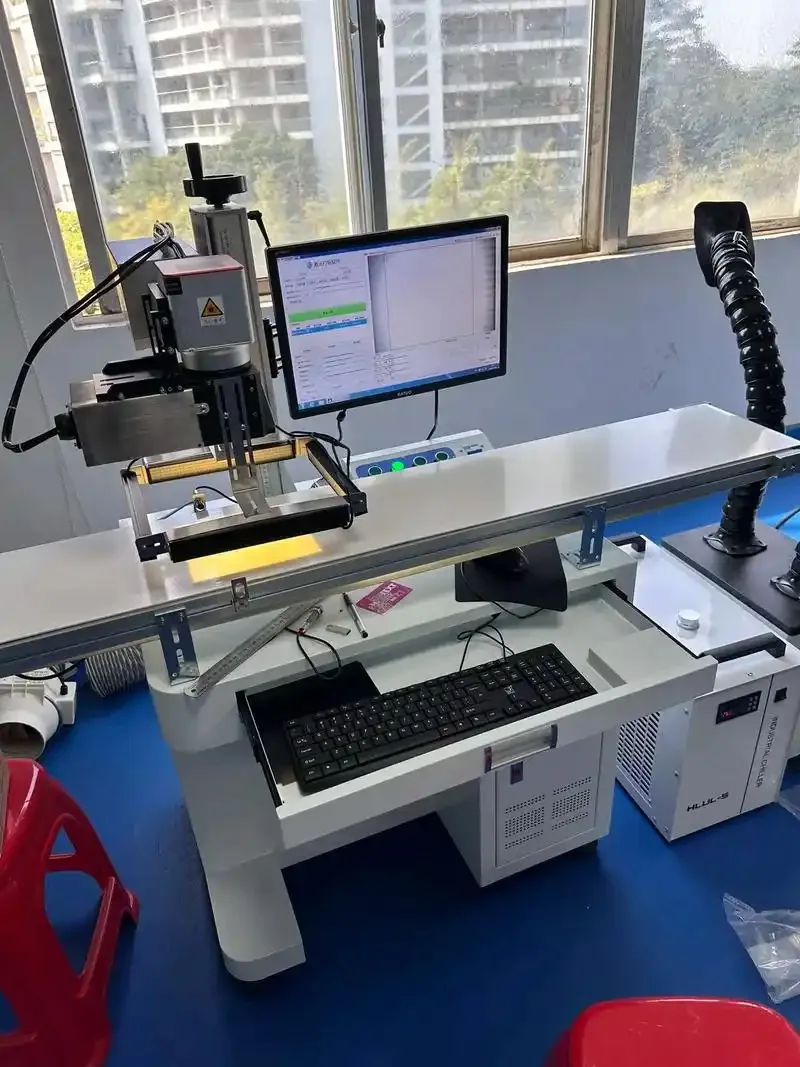
| ZR-FL-H04 fiber laser marking machine | The published product page lists a 1064 nm fiber source, 20 W / 30 W / 50 W options and marking fields including 120 x 75 mm standard with 110 x 110 mm and 150 x 150 mm options. | This confirms an available 1064 nm equipment route for controlled trials. It does not mean every PP formulation is suitable for fiber marking; the actual PP sample still decides compatibility. |
Frequently Asked Questions
Polypropylene Laser Marking FAQs
Why is PP harder to laser mark than some other plastics?
Many PP formulations absorb weakly at common near-infrared marking wavelengths, so the surface may not form a strong dark mark without the right pigment, filler or laser-sensitive additive. The actual compound must be tested.
Can a fiber laser mark polypropylene?
Sometimes, especially when the PP compound contains suitable additives or pigments. For natural, white or unmodified PP, a fiber test may produce weak contrast or heat effects, so do not select fiber only by material name.
Is UV laser better for PP?
UV can be a strong candidate for heat-sensitive plastic parts and small codes, but it is not automatically the best choice. Contrast, speed, surface change and machine cost should be compared on final PP samples.
Do I need laser marking additives for PP?
Many PP projects benefit from additives or a laser-markable masterbatch. The material owner should approve the compound for color, mechanical properties, compliance and end-use requirements before production.
What samples should I send for PP testing?
Send final molded PP parts in the real color and grade, plus material information, SDS if available, artwork or code, target contrast, minimum feature size, cycle-time target and durability requirements.
Can the same PP grade mark differently after adding a laser-marking additive?
Yes. A laser-sensitive additive or masterbatch can change how the formulation absorbs laser energy and can substantially change contrast or the usable process window. The comparison should keep the PP base grade, color target, molded condition, laser source, lens, artwork and acceptance method consistent so the additive effect is not confused with another variable.
What safety information is needed before PP laser marking trials?
Provide the PP grade, SDS, color masterbatch, additives, recycled content and any coating or ink information. Zhuorui should review extraction, filtration and enclosure needs before repeated tests or production marking.
Prepare a Practical Test
Send the Actual PP Part Before Choosing the Machine
Share the PP grade, color, additives, molded surface, mark content, target contrast, cycle time and durability requirement. Zhuorui Laser can use the sample result to recommend a machine configuration with clear limits.