
Nylon and PA Laser Marking
Nylon can be laser marked, but the workable process depends on the exact PA grade, color, filler package, additives, moisture condition, molded surface and the mark you need. Use the actual production part to compare laser routes before fixing the machine configuration.
Request a Quote Ask About PA Sample TestingCan Nylon and PA Be Laser Marked?
Yes. Many nylon and polyamide parts can be laser marked, but “nylon” is not a single laser process. PA6, PA66, PA12, glass-filled grades and modified compounds can respond differently, so approval should be based on the final production material rather than the resin family name alone.
Grade changes the process window
PA6, PA66, PA12 and modified blends can differ in thermal response, crystallinity, additives and moisture behavior. One approved sample should not be assumed to cover another grade.
Fillers change the surface
Glass fiber and mineral fillers can change roughness, light scattering and the risk of exposed reinforcement after marking.
The target result matters
A visible logo, a high-contrast serial number and a small Data Matrix code can require different process priorities even on the same PA compound.
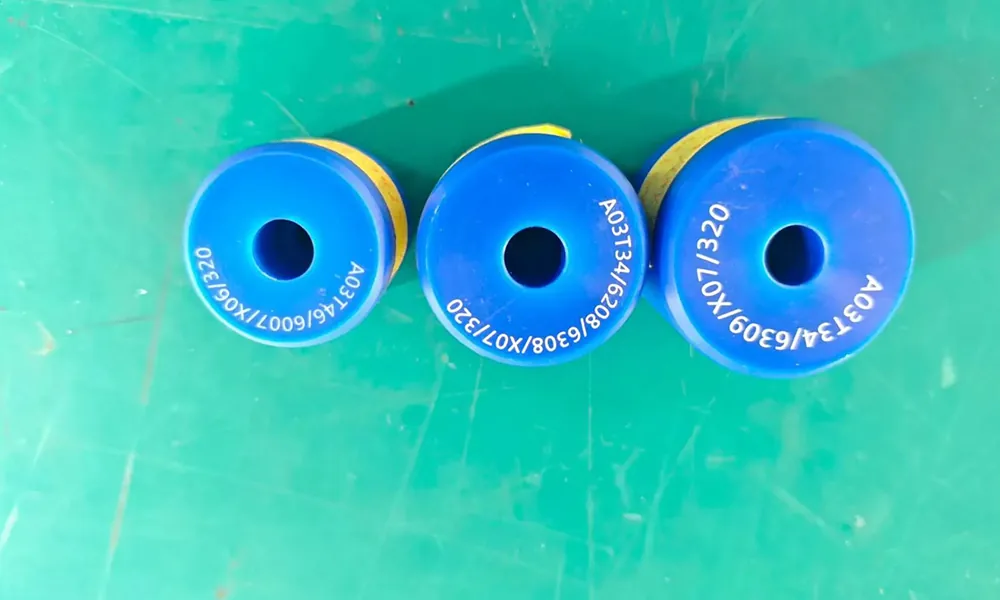
Use the Actual PA Compound to Approve the Mark
This nylon sample shows a clear light identification mark on molded blue parts. It is useful evidence that a nylon application can produce visible contrast, but it should not be treated as a universal PA6, PA66 or glass-filled result unless the exact grade and test condition are confirmed.
For production approval, match the real resin grade, color, reinforcement, surface texture and conditioning state.
Which Nylon Grade and Surface Condition Are You Actually Marking?
The material callout on a drawing is only the starting point. Supplier grade, reinforcement, color system, additives, molded texture, recycled content and moisture condition can move the marking result from clean and readable to faint, rough, burnt or inconsistent.
PA6
Common in molded engineering parts, cable ties, housings and industrial components. Confirm color, additive package, molding condition and real acceptance criteria.
PA66
Often used where higher mechanical and temperature performance is needed. Treat it as a separate marking qualification from PA6 unless testing shows equivalent results.
PA12 and Modified Blends
Used in tubing, flexible parts and specialty components. Do not copy a PA6 or PA66 recipe without checking the actual compound and surface.
Recycled or Regrind PA
Mixed regrind, recycled content and supplier changes can increase batch variation. Repeat qualification when the production material changes materially.
Moisture condition is part of the sample definition
Nylon absorbs moisture from its environment. For a meaningful approval, test parts in a condition that represents real storage, molding, assembly and production handling rather than relying on a clean laboratory coupon that does not match the final part.
Filled PA Can Behave Like a Different Marking Problem
A PA66-GF30 connector housing is not the same task as an unfilled black PA6 cable tie. Reinforcement, pigments, laser-sensitive additives, flame retardants and stabilizers can all change absorption, contrast, odor, residue and the surface finish after marking.
- Glass fiber can make a mark rougher or reveal reinforcement when too much material is removed.
- Carbon black and laser-sensitive additives can change how readily a compound produces dark or light contrast.
- Flame-retardant packages can change odor, residue and the safety review needed for repeated production marking.
- Natural, white and light-colored PA often need different contrast trials from black PA.
| Material input | What to confirm | Why it matters | What to inspect |
|---|---|---|---|
| PA grade | PA6, PA66, PA12, blend or modified compound | Changes the thermal and optical response | Contrast, edge definition, surface change and repeatability |
| Reinforcement | GF percentage, mineral filler, carbon fiber or unfilled | Can change roughness, scattering and material removal behavior | Fiber exposure, surface feel, code readability and durability |
| Color system | Black, natural, white, gray or colored masterbatch | Changes absorption and contrast direction | Readable contrast under real inspection conditions |
| Additives | Laser additive, flame retardant, stabilizer, lubricant or recycled content | Can improve marking or introduce residue, odor and variation | Appearance, residue, surface damage and batch stability |
| Surface condition | Mold texture, coating, contamination, moisture and conditioning state | The same compound can mark differently on a different finished surface | Uniformity, edge quality, adhesion of coatings and thermal effect |
Where Is Nylon Laser Marking Commonly Used, and Why?
Nylon is widely used for engineering parts where molded strength, temperature resistance, electrical performance or wear behavior matter. Laser marking is usually added for identification, traceability, assembly control or machine-readable coding without adding labels or ink to the part.
Automotive and EV Parts
Connector housings, clips, brackets and molded components may need part numbers, batch information or durable traceability codes that remain readable after assembly.
Electrical and Electronics
Terminal blocks, switches, cable ties and compact housings often require small text, polarity or identification symbols, cavity references and machine-readable codes.
Industrial Components
Gears, covers, brackets and technical molded parts may use laser marks for assembly identification, service tracking, inventory control or production traceability.
Consumer Products
Visible housings, handles and sporting components usually add a stronger cosmetic requirement: the mark must be readable without unacceptable melting or roughness around it.
Regulated or Validation-Heavy Parts
Where documentation, cleaning or other regulated requirements apply, material marking feasibility should be separated from the final compliance or validation decision.
Not sure the resin is actually nylon? Start with the Plastics & Polymers material guide and confirm the substrate before applying PA-specific marking assumptions.

Electrical & Electronics Context
Connector and electrical assemblies show why compact molded polymer parts often need permanent identification, cavity references or traceability. The image is application context; the exact polymer grade is not asserted as PA.
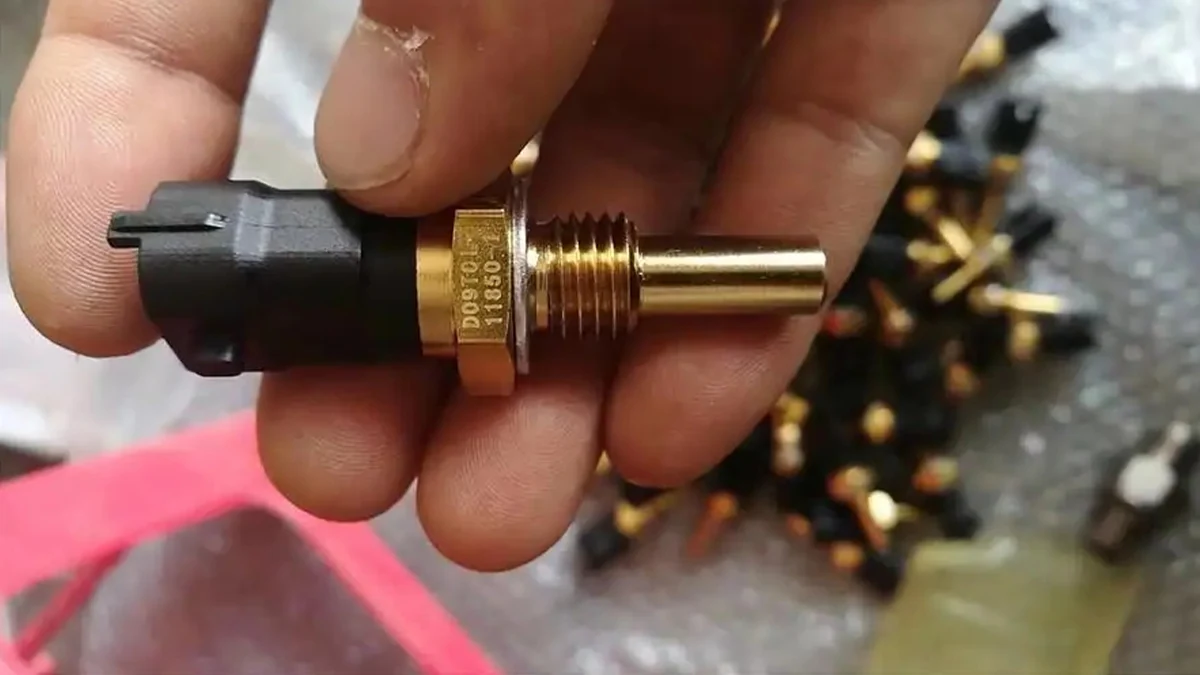
Industrial Component Context
Small mixed-material components illustrate the geometry and positioning constraints that can matter when a molded polymer housing is marked near metal inserts or functional features. Material identity must still be confirmed before PA approval.
The Mark Content Changes the Laser Requirement
A visible logo and a small Data Matrix code are different engineering tasks. The content determines the required line width, contrast, marking area, positioning accuracy and inspection method.
Identification
Product name, model, part number, logo, symbols and basic permanent labeling.
Traceability
Serial numbers, batch or lot codes, date codes and production references that connect a part to manufacturing records.
Machine-Readable Codes
Data Matrix, QR codes and other compact codes where module definition and reader validation matter more than a visually attractive photo.
Assembly and Process Marks
Cavity ID, position codes, inspection references or process identifiers used during assembly, sorting or downstream quality checks.
A Visible Code Still Has to Be Readable
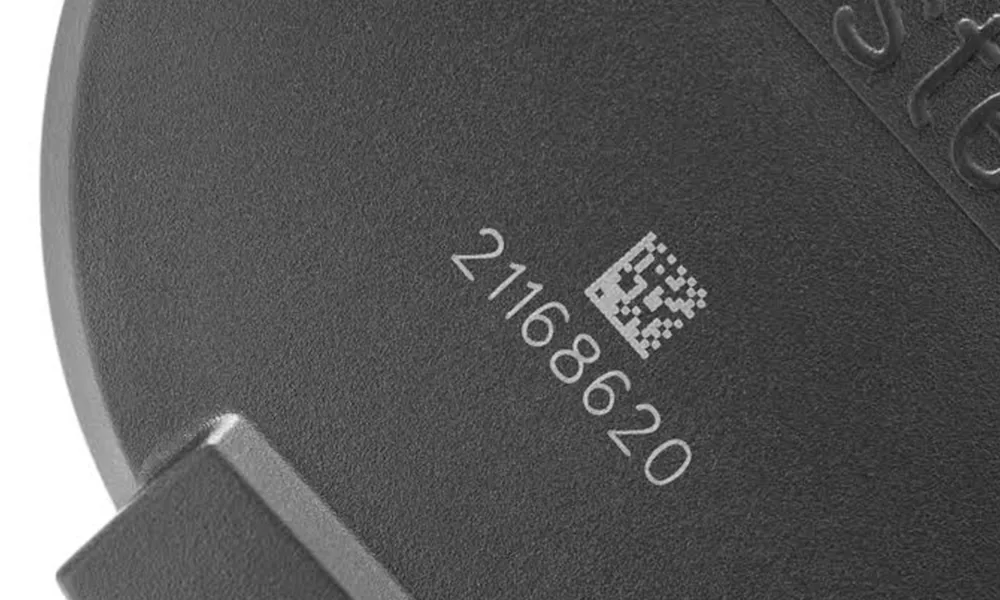
Small machine-readable marks place tighter demands on contrast, module edges and surface uniformity than a large logo or text mark. On PA, molded texture, glass fiber and local roughness can affect code quality even when the mark looks acceptable by eye.
The adjacent image is a representative plastic Data Matrix example, not proof of a specific nylon grade. Final acceptance should use the production PA part and the actual reader or inspection method.
Define the Result Before Comparing Laser Sources
The useful question is not simply whether nylon can be marked. Define whether the part needs a light mark, a dark mark, a fine machine-readable code, a cosmetic identification mark or intentional surface removal.
Light Mark on Dark PA
Common on black or dark compounds when the material forms a controlled light or gray change. Inspect contrast, edge definition, roughness and any exposed reinforcement.
Dark Mark on Light PA
May be achievable on suitable light or additive-assisted compounds. Watch for brown burning, residue, local melting or insufficient darkness.
Fine Codes and Small Text
Judge the smallest real character or code module, not only a large demo mark. Readability must remain stable on the production surface.
Cosmetic Identification
Uniform appearance, clean edges and limited visible thermal damage may matter as much as raw contrast on customer-facing surfaces.
Shallow Engraving or Texture
Use only when surface removal is acceptable. Inspect melt, debris, depth consistency and whether the remaining wall section still meets the part requirement.
Coating Removal
Painted or coated nylon should be treated as a coating-plus-substrate system. The pass condition is controlled layer removal without unacceptable damage to the PA below.
How Wall Thickness, Curvature and Part Size Change the Marking Setup
The same PA compound can require a different setup when the part changes from a flat plaque to a thin-wall connector, curved tube or large housing. Geometry affects heat tolerance, focus, positioning and the optical field needed to keep the mark consistent.
Thin Walls and Ribs
Thin sections can be more sensitive to local heating. Check deformation, melt, raised edges and whether the marked area sits near a snap feature, sealing face or load-bearing rib.
Curved or Height-Varying Surfaces
Curvature and height changes can shift focus and spot size across the mark. Fixture orientation, rotary handling or height compensation may become more important than nominal laser power.
Small Parts
Connector bodies and compact molded parts often make positioning, mark-to-edge distance and fixture repeatability the main constraints.
Large Parts
Large housings can require a larger marking field, multiple marking positions or controlled part indexing. Lens and field choice should follow the real mark area.
Molded Texture
Leather grain, matte mold finish and visible fiber texture can reduce apparent contrast and disturb small code edges even when the chemistry is unchanged.
Metal Inserts and Assemblies
Nearby terminals, inserts and fixtures can change reflection paths, access and positioning. Review the complete assembled marking area, not only the plastic resin.
Which Laser Route Should Be Compared First?
Do not select a nylon marking machine from wattage alone. Start from the real compound, required result, smallest code or text, acceptable surface change and production geometry, then compare the most plausible laser routes on the actual part.
Typical routes include fiber and MOPA fiber laser marking systems, UV laser marking systems and, for selected removal or texturing tasks, CO2 laser marking systems. Green laser should remain a secondary comparison route unless sample results show a clear reason to use it.
| Actual PA condition | Early comparison direction | What decides whether it passes |
|---|---|---|
| Black or dark PA needing a light identification mark | Fiber/MOPA can be an early route; add UV when fine detail or surface integrity is especially important | Contrast, roughness, edge definition, fiber exposure and repeatability |
| Light or natural PA needing a dark mark | Compare UV and suitable 1064 nm response on the actual compound, especially if the resin includes laser-sensitive additives | Darkness, thermal discoloration, melt, residue and stability between batches |
| Fine Data Matrix or very small text | Give UV an early comparison when small feature definition and limited visible surface damage are priorities | Module shape, quiet area, scanner readability, edge quality and cycle requirement |
| Glass-filled PA | Test the real GF grade with the leading fiber/MOPA and/or UV candidates | Fiber exposure, roughness, code readability and contrast uniformity |
| Painted or coated PA | Treat the coating and substrate as one system; compare the source that removes the coating cleanly with the least substrate damage | Complete layer removal, edge quality, substrate damage and residue |
| Intentional engraving or texturing | CO2 or another thermal-removal route may enter the comparison when material removal is acceptable | Depth, melt, debris, dimensional effect and edge quality |
A first-test direction is not a final machine specification
The purpose of the first comparison is to identify a stable process window. Final source, power class, lens, fixture, enclosure, extraction, vision and automation should follow an approved sample result and the real production target.
Decide whether to change the laser route or the PA formulation
Do not keep increasing energy without first deciding which side of the process is still adjustable.
Production material is locked
Keep the real PA compound unchanged and compare the most plausible laser routes and process windows on that same part. If none reaches the required contrast without unacceptable heat, roughness or fiber exposure, re-check whether the target result is realistic for the fixed formulation.
Material formulation can still change
Work with the resin or masterbatch supplier to evaluate a laser-markable PA grade or a suitable laser-sensitive additive, then repeat qualification on the revised production compound. A material change creates a new approval condition; it should not inherit the old sample result automatically.
What Usually Goes Wrong When Nylon Marking Is Not Properly Qualified?
Most failures are not simply “the laser cannot mark nylon.” They come from a mismatch between the PA formulation, required effect, energy input, part geometry and acceptance criteria.
Safety and fume review still belongs in the qualification
Request SDS and additive information for unknown compounds, review local exhaust and filtration for repeated marking, and evaluate enclosure, interlocks, beam containment and wavelength-appropriate protective measures for the final laser system. Mixed plastics, halogenated materials and coated assemblies should not be treated as clean base nylon without verification.
How to Confirm a Nylon Mark Before Choosing the Machine
The sample test should reproduce the production material, surface and marking requirement closely enough that the result can become a purchasing decision rather than a one-off demonstration.
| Sample input | What to provide | Why it matters |
|---|---|---|
| PA identity | PA6, PA66, PA12, blend, supplier grade and batch where relevant | Prevents generic nylon assumptions from driving a specific machine recommendation. |
| Reinforcement | Glass-fiber percentage, mineral filler, carbon fiber or unfilled grade | Controls surface roughness, reinforcement exposure and contrast behavior. |
| Color and additives | Black, white, natural, colored masterbatch, laser additive, flame retardant, stabilizer or recycled content | Affects absorption, mark direction, residue and batch stability. |
| Production surface | Mold texture, coating, moisture/conditioning state, wall thickness and nearby assembly features | Connects the test result to the finished workpiece rather than an ideal coupon. |
| Mark content | Logo, text, serial number, QR, Data Matrix, minimum character or module size and artwork | Defines the real feature size, marking field and inspection requirement. |
| Acceptance target | Light/dark contrast, cosmetic limit, code readability, durability requirement and allowed surface change | Creates a pass/fail condition instead of relying on a subjective sample photo. |
| Production target | Manual load, fixture, tray, rotary, conveyor, cycle expectation and inspection need | Connects material feasibility to the final equipment configuration. |
| Safety data | SDS, additive information, extraction constraints and operator access limits | Supports safe trial preparation and system-level extraction and enclosure planning. |
Do not use a substitute coupon for final approval
If the production part is glass-filled, flame-retardant, colored, textured, conditioned or molded under a specific process, the submitted sample should match that condition. An unfilled nylon plaque can give the wrong recommendation for a finished PA component.
How an Approved PA Sample Becomes a Final Machine Configuration
Once the sample has a stable and acceptable process window, the remaining decisions are equipment decisions: how to reproduce that mark over the required field, geometry, loading method, safety condition and production cycle.
Laser Source
Use the route that produced the approved PA result. Do not change wavelength or pulse behavior only to chase a higher nominal wattage.
Lens and Marking Field
Match the field to the code size, character size, marking area and workpiece dimensions. A larger field is not automatically a better precision choice.
Fixture and Focus
Define how small parts, curved parts or multiple cavities will be positioned and kept inside the qualified focal condition.
Vision or Motion
Add vision, rotary handling, height compensation or other motion only when the part geometry and production workflow justify it.
Enclosure and Extraction
Configure beam containment and fume handling around the selected source, actual PA formulation and operating method.
Production Integration
Finish the configuration with loading method, data flow, code verification, target cycle time and any PLC or automation requirement.
What to send for a useful quotation
Send the final PA part or representative production sample, exact grade and filler information, color and additives, mark artwork or code, required result, marked area, workpiece dimensions, target cycle, loading method and any vision, rotary, enclosure, extraction or automation requirement. That information allows the quotation to follow the tested process instead of starting from a generic machine model.
Nylon and PA Laser Marking FAQs
Can nylon be laser marked?
Yes. Many nylon and polyamide parts can be laser marked, but the result depends on the exact PA grade, color, moisture condition, fillers, additives, molded surface and required mark effect. Final parts should be tested before choosing the machine.
Are PA6 and PA66 marked the same way?
No. PA6 and PA66 should normally be qualified separately because resin grade, crystallinity, moisture behavior, pigments, additives and molded surface can change the marking window and final appearance.
How does glass fiber affect nylon laser marking?
Glass fiber can change surface texture, light scattering and material-removal behavior. The main risks are roughness, uneven appearance and exposed fibers, so the actual GF grade and surface should be tested.
Which laser should be tested first for nylon?
There is no universal best laser for every PA compound. Fiber/MOPA and UV are common early comparison routes for many identification and code-marking tasks, while CO2 may be evaluated for selected removal or texturing work. The actual compound and target result decide the useful route.
Why can the same nylon mark differently between batches?
Supplier grade, color masterbatch, recycled content, additives, molding condition and moisture state can all change the surface response. A material change should trigger a review of the previously approved process window.
Should nylon be tested dry or conditioned?
Test it in the condition that represents real production and use. If parts are normally conditioned, stored in ambient humidity or assembled after a defined drying process, the sample should reflect that state rather than an unrelated laboratory condition.
Can glass-filled nylon be marked without exposing fibers?
It can be possible on suitable compounds and process windows, but fiber exposure is one of the main acceptance checks. The real GF percentage, molded surface and required contrast should be tested together.
Send the Final Nylon Part, Grade and Mark Requirement
Include PA6, PA66 or other PA grade, supplier grade where available, glass-fiber level, color, additives, conditioning state, surface texture, workpiece dimensions, artwork or code, target contrast, cycle expectation and acceptance criteria. Zhuorui Laser can use the sample result to narrow the laser route and then configure the source, lens, fixture, enclosure, extraction and production options around the approved mark.
Request a Quote OEM & Custom Inquiry Contact Us