
Polyethylene Laser Marking
Evaluate PE color, additives and low-contrast risk before choosing a laser marking machine. HDPE, LDPE, LLDPE and UHMWPE can mark differently, so the final resin grade, pigment package and molded surface should be tested before production approval.
Request a Quote Ask About PE Sample TestingYes — but PE Formulation and Contrast Window Decide Whether the Result Is Useful
Polyethylene can be laser marked, but a successful result cannot be approved from the polymer name alone. HDPE, LDPE, LLDPE, UHMWPE, recycled blends, pigments and additives can respond differently to the same wavelength. Natural or light PE may produce weak contrast, while black, filled or laser-additive PE can respond much more strongly.
Start with the final PE grade
Use the production resin, color and molded surface for testing. A generic PE coupon cannot represent every grade, supplier or formulation.
Contrast is not guaranteed
A mark can be technically visible but still fail a cosmetic or machine-readable requirement. Readability, surface integrity and repeatability should be treated as separate acceptance criteria.
Higher power is not the shortcut
If the material does not absorb the selected wavelength well, adding energy can increase melting, gloss change or distortion without creating the contrast you need.
PE Type, Color, Additives and Surface Condition All Matter
PE is a family of materials rather than one marking behavior. The density family, pigment package, fillers, recycled content and final surface condition can change absorption, contrast, melting tendency, odor and surface appearance.
HDPE
Common in bottles, caps, containers, pipe and molded industrial parts. Surface texture, color and wall thickness should be included in the test plan.
LDPE and LLDPE
Often used in films, tubing and flexible packaging. Deformation, haze, melting and loss of flatness can become as important as contrast.
UHMWPE
Wear parts and low-friction components should be checked for surface roughness, debris, heat effect and whether the mark survives the actual service condition.
Blended or Recycled PE
Mixed resin streams and recycled content can introduce batch variation. Supplier or batch changes should be treated as a reason to re-check the process window.
Color and Pigments
Natural, white, black and colored PE should not share one approval result unless testing proves they achieve the same contrast and surface quality.
Fillers and Additives
Carbon black, mineral fillers, stabilizers, flame retardants and laser-sensitive additives can shift absorption and change the useful wavelength range.
Molded Surface and Texture
Glossy, matte, textured or molded-grain surfaces change how the mark looks and how a camera or scanner sees its edges and contrast.
Printing, Coating and Contamination
Ink, coating, release agent, oil or surface contamination can turn a bare-PE problem into a layer-removal problem. Test the actual surface stack.
A laser-sensitive additive is a material decision
If the existing formulation cannot produce the required contrast, a laser-sensitive additive may be worth evaluating with the resin supplier. That changes the material qualification path, so it should be approved together with the final PE formulation rather than treated as a machine-setting adjustment.
Polyethylene Parts Are Marked for Identification, Traceability and Product Information
The marking requirement normally comes from the product and production process. The same PE family may need a simple logo on one part and a small machine-readable code on another, which changes the acceptance criteria and equipment setup.
Bottles, Caps and Packaging
Common needs include lot or batch identification, date information, product codes, branding and variable data on containers, closures and packaging components.
Pipe, Tube and Cable Jackets
Repeated identification, product type, production codes and traceability marks may need to run along long or cylindrical PE products. Part motion and focus stability become important.
Automotive and EV Components
Molded reservoirs, covers, clips and other PE parts may need part numbers, serial or batch information, assembly identifiers or machine-readable traceability codes.
Electrical and Utility Parts
PE housings, protective parts and cable-related products may require identification, installation information or traceability while preserving the functional surface.
Consumer Products
Containers, handles, household parts and molded products may use laser marks for logos, model identification, product information or durable decoration.
Regulated or Medical Uses
Where PE is used in regulated products, identification and traceability requirements may be more demanding. Material, readability, durability and documentation requirements should be validated for the actual end use.
Use the Finished PE Part to Judge Contrast and Readability
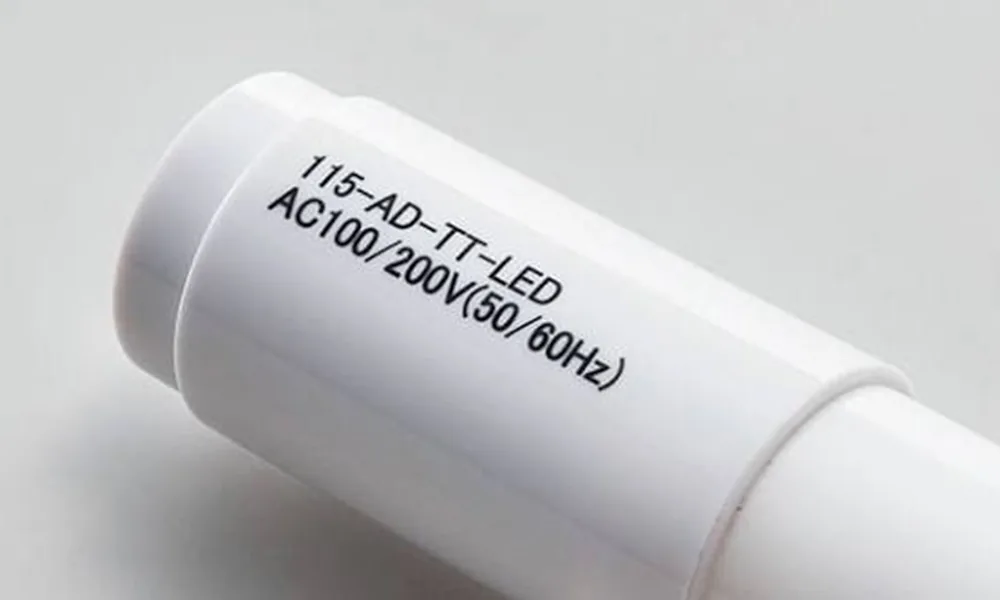
This polyethylene example shows dark text on a white molded part. It is useful for judging the kind of visual contrast a PE marking project may target, but it should not be treated as a universal result for every PE grade, color or additive package.
For production approval, compare the actual resin grade, molded surface, wall thickness and required code or artwork under the intended viewing or reader conditions.
Define the Information Before You Define the Laser
Mark content controls minimum line width, code size, contrast requirement, positioning tolerance and inspection method. A large logo and a small Data Matrix code should not be evaluated as the same marking task.
Branding and Product ID
Logos, model names and product identifiers normally prioritize cosmetic consistency and clean edges.
Traceability Data
Serial, lot, batch and date information needs repeatable character formation and stable contrast over the production range.
Machine-Readable Codes
QR, Data Matrix and barcodes should be approved with the intended reader, code size, lighting condition and real production surface.
Line or Position Marks
Long products may need repeated identification, orientation or spacing marks, which can move the project from static marking to line integration.
Choose the Required Result Before Comparing Machines
A useful PE test should define what the finished mark must look like and how it will be accepted. High contrast, light-on-dark, dark-on-light, tactile texture, layer removal and machine-readable codes are different process targets.
Dark Visible Mark
Useful only if the formulation creates stable contrast without unacceptable melting or gloss change.
Light or Foamed Mark
May suit selected darker formulations when a pale or slightly raised surface effect is acceptable.
Fine Text or Code
Requires edge definition and enough cell contrast for the intended reader and lighting condition.
Texture or Engraving
Can suit utility marks, but roughness, debris, dimensional change and heat effect must be checked.
Layer Removal
Applies when ink, coating or another top layer is removed rather than directly changing bare PE.
| Target result | Typical use | Main PE risk | Acceptance check |
|---|---|---|---|
| Dark high-contrast mark | Text, logos and codes | Weak or unstable contrast on natural/light PE | Contrast, edge quality, lighting condition and batch repeatability |
| Light or foamed mark | Dark or selected colored PE | Swelling, gloss change or inconsistent appearance | Surface height, appearance, tactile change and durability |
| Fine serial / Data Matrix | Traceability | Rounded cells, low cell contrast or reader failure | Minimum code size, reader result and full-cycle repeatability |
| Texture / engraving | Utility or tactile marks | Melting, roughness, debris or dimensional change | Depth, cleanliness, heat effect and post-cleaning need |
| Coating / ink removal | Layered or printed PE | Uneven removal or substrate damage | Layer removal, substrate protection, fumes and wear behavior |
The Same PE Resin Can Need a Different Setup on a Film, Bottle, Cap or Pipe
Geometry changes heat tolerance, focus control, fixturing, accessible marking area and how the part moves through the machine. These factors should be defined before the final optics, handling method or automation route is selected.
Thin Film and Flexible Packaging
Low stiffness and low thermal mass can make wrinkling, haze, pinholing or loss of flatness more important. Web tension and motion should also be considered for online marking.
Thin-Wall Bottles and Containers
Local heating can show as distortion, denting or gloss change. Test on the real wall thickness and molded surface, not only a thick plaque.
Caps and Small Molded Parts
Small parts may need fixtures or vision positioning. Curved tops, ribs and molded texture can reduce the usable flat marking area.
Tube, Cable and Pipe
Curvature changes focus across the mark. Long products may also need rotary handling, synchronized motion or flying marking rather than a simple stationary fixture.
Large Flat Parts
Large marking areas can require a larger field, multiple positions or part movement. A wider field should not be assumed to preserve the same fine-detail capability.
Coated or Multi-Layer Parts
Wall thickness alone is not enough. A printed, laminated or coated surface should be treated as a complete layer stack because the top layer may control the first laser interaction.
Geometry can change the machine configuration even when the laser source stays the same
Once the material response is acceptable, part shape and size determine whether the job needs a standard table, custom fixture, rotary axis, vision positioning, larger working field, conveyor or flying-marking integration.
Use a Practical Screening Route Instead of Choosing from PE Name Alone
Laser wavelength, PE formulation and target result must work together. UV, near-infrared fiber/MOPA, CO2 and a conditional green route can produce different responses. The first test should be chosen from the actual color, additive package, surface sensitivity and desired mark — not from wattage alone.
Zhuorui Laser can compare practical sample-test directions using UV laser marking machines, fiber or MOPA fiber systems, CO2 laser marking machines and, where the real sample justifies it, a green laser route.
| PE condition / target | First route to screen | What decides the next step |
|---|---|---|
| Natural, white or light PE needing a dark mark | Screen UV early; compare another wavelength if contrast remains weak | If the formulation has no useful contrast window, review pigment/additive strategy instead of simply increasing energy. |
| Black, dark, filled or laser-additive PE | Screen fiber/MOPA early when near-infrared absorption is plausible | Compare UV when fine detail, cosmetic surface quality or heat-related damage becomes the limiting factor. |
| Thin film or thin-wall PE | Screen UV early with deformation and surface checks | Reject any route that gives acceptable contrast only by causing wrinkling, pinholing, haze or dimensional change. |
| Printed or coated PE | Test the actual top layer and substrate together | Choose the route that removes or changes the intended layer without unacceptable substrate damage. |
| Texture or engraving-type result | Evaluate CO2 or another route that gives controllable surface change | Accept only if melting, roughness, smoke, debris and dimensional change stay within the product requirement. |
| Unknown, recycled or highly variable PE | No single default route — run a small wavelength/sample matrix | Use the most repeatable process window across representative batches, not the best-looking one-off mark. |
Green laser is a conditional comparison route, not the default answer
If UV and near-infrared testing do not create an acceptable balance of contrast and surface quality, a green wavelength can be evaluated when suitable equipment and the actual PE response justify the comparison.
Know What a Failed PE Test Looks Like Before You Approve the Process
The most useful PE trial is not the one that creates the darkest single mark. It is the one that produces the required result repeatedly without damaging the part, creating an unreadable code or introducing an unacceptable production or safety problem.
Weak or No Contrast
The selected wavelength or formulation does not create enough optical change for the required visual or reader result.
Melting, Gloss Change or Swelling
The process creates visible surface change before acceptable contrast is reached.
Warping, Haze or Pinholing
These failures matter especially on thin films, thin-wall containers and heat-sensitive PE parts.
Poor Code Readability
Cells or character edges become rounded, inconsistent or too low contrast for the intended reader.
Batch-to-Batch Variation
Recycled content, pigment or supplier changes can move the process outside the approved window.
Residue, Odor or Smoke
Repeated processing can create contamination or extraction requirements even when the visual mark looks acceptable.
Safety is one part of the failure review
Unknown recycled PE, coatings, inks, fillers or mixed plastic structures should be reviewed before testing. Where formulation is uncertain, request SDS or material information, separate PE from halogenated or unknown plastics, and evaluate smoke, odor, residue, extraction, filtration, enclosure, interlocks, emergency stop and beam containment for the actual laser system.
Use Final Production Parts and Approve Both the Mark and the Process Window
PE sample validation should answer two different questions: can the required mark be produced, and can it be produced repeatedly without unacceptable surface, geometry, safety or cycle problems? Test the final PE grade, color, molded finish and representative production condition.
| Sample input | What to provide | Why it matters |
|---|---|---|
| PE type | HDPE, LDPE, LLDPE, UHMWPE, blend or recycled stream | Different PE families and blends can change heat response and contrast. |
| Grade and supplier | Resin grade, supplier, representative batch and molding condition when available | Prevents approving one material and buying equipment for another. |
| Color and additives | Natural, white, black or colored PE; pigments, fillers, stabilizers, flame retardants and laser additives | Changes absorption, contrast window, odor and repeatability. |
| Surface condition | Molded texture, gloss, printing, coating, release agent or contamination | The final surface can change both appearance and laser interaction. |
| Mark content | Logo, serial number, lot/date code, QR, Data Matrix, text size or artwork | Defines feature size, required edge quality and inspection method. |
| Part geometry | Film, flat plate, cap, bottle, tube, cable jacket, pipe, curved housing or other fixture constraint | Determines focus control, handling, fixturing and whether static, rotary or moving-line marking should be evaluated. |
| Production target | Output, line speed, loading method, code verification, durability and reject criteria | Connects material feasibility to a realistic machine configuration. |
| Safety data | SDS, coating information and extraction constraints when relevant | Supports safe trial preparation and fume/extraction review. |
Approve the Sample Against Clear Criteria
Do not approve a PE sample from appearance alone. The process should meet visual, readability, surface-integrity, durability and repeatability requirements under the intended production condition.
- Required visual contrast under realistic lighting
- Sharp enough characters or code cells for the intended reader
- No unacceptable melting, swelling, haze, gloss change, warping or pinholing
- Acceptable residue, odor and cleaning requirement
- Durability appropriate to the real handling, abrasion, cleaning or exposure requirement
- Repeatability across representative parts, batches and production conditions
- Cycle behavior that can be transferred to the intended loading or line process
Do not use a substitute sample for final approval
If the production part is colored, textured, recycled, coated, filled or molded under a specific process, the submitted sample should match that condition. A clean natural PE coupon can lead to the wrong machine direction for a finished product.
Use the Approved PE Result to Define the Machine — Not the Other Way Around
Once the sample test establishes a repeatable marking window, the equipment can be configured around the real part, marking field, loading method, production rate, inspection requirement and safety boundary.
Laser Source and Pulse Behavior
Select the wavelength and source family that produced the best balance of contrast, surface quality and repeatability on the approved PE sample.
Lens and Marking Field
Match the required field size, character or code size and working distance. A larger field should not be assumed to preserve the same fine-detail performance.
Fixture, Rotary or Part Handling
Flat parts may use a standard worktable, while caps, tubes, cable, pipe or irregular molded parts can require dedicated fixtures, rotary handling or multi-position loading.
Static, Vision or Flying Workflow
Choose static marking, vision-assisted positioning or moving-line integration according to part variation, positioning tolerance, line motion and actual cycle requirement.
Extraction and Safety Configuration
Use the test result and material information to define extraction needs, enclosure, interlocks, beam containment and operator-safety requirements for the complete machine layout.
Data, Inspection and Production Acceptance
If marks contain variable data or machine-readable codes, confirm data source, code generation, reader or inspection method, reject logic and production acceptance criteria before quotation.
What to send for a useful quotation
Include the PE family and grade, supplier if known, color and additives, final part photos or samples, wall thickness and dimensions, surface condition, artwork or code, target marking result, required marking area, expected output or line speed, loading method, inspection requirement, durability criteria and any safety or extraction constraints.
Polyethylene Laser Marking FAQs
Can polyethylene be laser marked?
Yes. PE can be laser marked in many formulations, but the usable result depends on PE type, color, additives, surface condition, target mark and wavelength. Final approval should be based on the production material.
Why is PE laser marking sometimes low contrast?
Some natural or light PE formulations do not absorb a selected wavelength strongly enough to create a dark, readable mark. Pigments, carbon black, fillers and laser-sensitive additives can change the response.
Is HDPE easier to mark than LDPE?
Do not assume one is always easier. Density family, color, additives, wall thickness, surface texture and molding condition can all affect contrast and heat response, so HDPE and LDPE should be tested as separate materials.
Which laser is best for PE marking?
There is no universal best source for every PE formulation. UV, fiber/MOPA, CO2 and sometimes green can be evaluated according to the actual material, target effect, heat sensitivity and production requirement.
Do laser marking additives help polyethylene?
They can improve absorption or contrast in some projects, but they become part of the material formulation and should be reviewed with the resin supplier and end-use requirements.
Can one approved setting be reused for every PE color or supplier?
Not safely by default. A change in color, pigment package, recycled content, supplier or molding condition can move the material response. Re-test when the change could affect contrast, heat response or durability.
Can I approve a machine from a generic PE sample?
A generic sample is useful for early screening, but final machine approval should use the actual production PE part or a sample that matches its grade, color, additives, thickness and surface condition.
Send the Final Polyethylene Part, Color and Mark Requirement
Include the PE family, resin grade, supplier, color, additives, recycled content, part geometry, wall thickness, artwork or code, target contrast or surface effect, cycle expectation, durability criteria and SDS or safety notes when relevant. Zhuorui Laser can use the sample result to narrow the laser route and machine configuration before quotation.
Request a Quote OEM & Custom Inquiry Contact Us