Jewelry Application Guidance
Personalized Jewelry Laser Engraving
Define the jewelry type, material and surface, engraving content, target result, positioning method and order workflow before choosing a laser setup. Representative sample tests should then confirm the result and determine the final source, optics, workholding and production configuration.
Product & Workpiece Scope
Which Jewelry Products Are Commonly Personalized by Laser?
This page applies to finished or semi-finished jewelry pieces that need customer-specific text or artwork and have an accessible marking area that can be positioned and sample-tested safely.
Rings and Bands
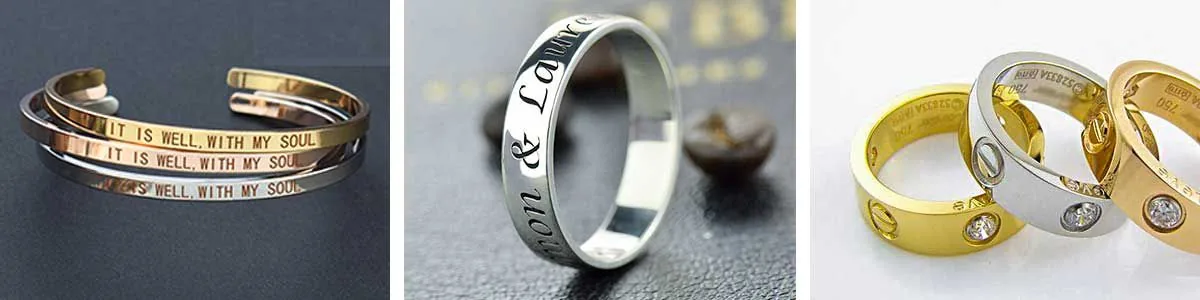
Names, dates, symbols or short messages may be placed on an outer face, inner band or another defined area. Curvature, access and orientation determine whether a fixture alone is sufficient or rotary evaluation is needed.
Pendants, Tags, Lockets and Charms
Flat or locally flat surfaces are often easier to locate, but small usable areas still make text size, edge clearance and repeatable positioning important.
Bracelets and Bangles
Flat inserts, inner surfaces and curved outer surfaces can require different workholding. The mark position should be defined before deciding whether a nest, clamp or rotary setup is appropriate.
Small Custom Jewelry Components
Small plates, tokens and other jewelry components can also fit this workflow when the material, surface construction, accessible mark area and handling method are known.
Why Mark
Why Is Jewelry Personalized by Laser?
The purpose is usually not industrial traceability alone. Personalized jewelry uses the marking process to create customer-specific value while keeping the content, placement and appearance repeatable enough for production.
Customer-Specific Pieces
Names, dates, messages and symbols turn a standard jewelry piece into an order-specific product without requiring a new mechanical engraving tool for every design.
Decorative and Brand Differentiation
Patterns, small logos and custom artwork can support gift collections, limited editions or branded jewelry when the required finish can be reproduced on the actual surface.
Frequent Order Variation
Laser processing is especially useful when the content changes frequently and the production workflow needs fast file changes, repeatable positioning and controlled small-batch handling.
What Is Marked
What Is Usually Engraved on Personalized Jewelry?
The marking content should be defined before sampling because character size, line density, filled artwork and available mark area can change both visual quality and processing requirements.
Names and Initials
Personal names, initials and monograms need a readable size, correct spacing and a layout that fits the usable area without crowding edges or curved transitions.
Dates and Short Messages
Anniversary dates, coordinates and short messages often require tighter layout control because the same piece may need more characters than a simple name.
Symbols, Patterns and Custom Artwork
Decorative motifs, line art and filled graphics should be tested at the actual scale because fine features and dense fills can behave differently from simple text.
Saved Templates and Repeated Designs
Frequently reordered layouts benefit from controlled templates, job naming and version checks so the correct content can be recalled without rebuilding the setup each time.
Result Variables
What Determines the Personalized Jewelry Engraving Result?
The visible result is controlled by more than the jewelry material name. Surface construction, geometry, artwork, positioning and the selected process window interact with each other.
Alloy, Plating and Coating
Base alloy, plated layers, coatings and mixed decorative surfaces can respond differently. A result that is acceptable on bare metal should not be assumed to transfer to plated or coated versions.
Polish, Texture and Surface Condition
High polish, brushing, oxidation, residues or prior finishing can change absorption, visible contrast and the amount of surface change the customer considers acceptable.
Character Size and Graphic Density
Small text, thin lines, dense filled areas and fine artwork place different demands on spot size, scan strategy and the stability of the selected process window.
Curvature and Focus Consistency
A mark that crosses a curved surface can move away from the best focus condition. The usable area and height variation should be known before finalizing optics or motion requirements.
Fixture and Locating Repeatability
Even a good laser process cannot compensate for a part that shifts, rotates or is loaded differently from one order to the next. Positioning tolerance must match the visual acceptance requirement.
Laser Route and Parameter Window
Source behavior, optics, focus, scan strategy, pulse conditions and pass count affect contrast, depth, edge quality and heat input. The acceptable combination should be found by controlled sample testing.
Target Result
What Personalized Jewelry Engraving Result Should You Target?
Before testing a laser, translate “engrave this name or pattern” into an acceptance target that engineering and production can actually compare.
Correct and Readable
The right text or artwork must remain legible at the required size, with fine features and spacing preserved well enough for the intended viewing distance.
Defined Visual Effect
State whether the goal is visible contrast, a bright or dark surface effect, shallow engraving, deeper engraving or another approved appearance rather than using “good quality” as the criterion.
Controlled Placement
Define the engraving zone, orientation and acceptable offset from edges, features or centerlines so the fixture and positioning method can be evaluated against a real tolerance.
Acceptable Surrounding Finish
Confirm how much visible heat tint, texture change, edge roughness or disturbance to nearby polish, plating or decorative features is acceptable after marking.
Geometry, Positioning & Handling
How Do Jewelry Shape, Positioning and Part Handling Affect Engraving?
The right workholding method depends on where the mark sits, how the jewelry is loaded and whether the marking surface stays within an acceptable focus and orientation range.
Flat or Locally Flat Surfaces
Pendants, tags and flat inserts may only need a repeatable nest, stop or tray when the mark area can be presented consistently under the scan field.
Curved and Circumferential Surfaces
Rings and bracelets or bangles should be evaluated from the actual engraving arc. Rotary support is useful when rotation is needed to keep the mark path properly presented; it is not automatic for every curved jewelry job.
Manual Loading and Changeover
One-off orders need a setup that lets the operator load a new piece, orient it correctly and change artwork without rebuilding the full fixture or machine setup.
When Vision Is Worth Evaluating
Vision can help when part placement varies or alignment tolerance is tight, but it does not replace stable workholding or solve uncontrolled height and curvature by itself.
Laser Route & Sample Test
Which Laser Route Should Be Sample-Tested First?
Start from the real substrate, surface construction and target effect. The first test route should be the one most likely to meet the result with the least unnecessary process complexity, then alternatives can be compared if the acceptance target is not met.
| Route to evaluate | When it is a reasonable starting point | What the sample must prove | Do not assume |
|---|---|---|---|
| Conventional pulsed fiber | Common starting route for many metal jewelry substrates when the target is engraving or a controlled surface mark on an accessible metal area. | Readability, required contrast or depth, edge quality, surrounding finish and repeatability on the actual alloy and surface condition. | Do not select power or final configuration from the word “metal” alone. |
| MOPA fiber | Worth comparing when a wider pulse-control window may help tune surface effect, heat input, fine detail or the balance between appearance and material removal. | Whether the additional pulse control produces a measurably better accepted result or a more stable process window on the buyer’s actual part. | Do not treat MOPA as an automatic upgrade if a simpler fiber route already meets the acceptance target. |
| UV or another justified route | Evaluate when the actual surface is heat-sensitive, coated, mixed-material or otherwise gives a clear reason to compare a different wavelength/process interaction. | Whether the required mark can be produced without unacceptable change to the surface layer, nearby finish or decorative construction. | Do not assume UV is safer for every jewelry assembly, gemstone, adhesive or coating; representative testing is still required. |
Material & Surface Testing
When Does the Material or Surface Need Separate Testing?
Separate material testing becomes important when the main uncertainty is no longer the personalization workflow itself, but how the actual alloy, plating, coating, polish or other surface condition responds to the selected laser process.
Define the Personalization Job First
First define the jewelry type, engraving content, mark position, target result, batch mode, fixture or rotary requirement, changeover workflow and sample acceptance criteria.
Jewelry & Precious Metals hub · Gold, Silver & Precious-Metal Jewelry Marking
Test the Actual Material and Surface Separately
When alloy response, plating behavior, coating sensitivity or finish preservation is the main uncertainty, test that actual material and surface condition separately and use the relevant material guidance to frame the sample test.
Failure Modes
What Commonly Goes Wrong in Personalized Jewelry Engraving?
The highest-cost failures are not always weak marks. Personalized production can also fail because the wrong artwork is loaded, a small part shifts, a curved surface moves out of the accepted process condition or the first sample cannot be repeated.
Wrong Name, Artwork or Job Version
A technically good mark is still scrap if the customer content, orientation or saved template is wrong. Order data and file version should be verified before marking.
Position or Orientation Drift
Small jewelry pieces can rotate or seat differently in the fixture, producing visible placement errors even when the laser parameters remain unchanged.
Uneven Result Across Curvature
Focus and incident geometry can change across rings, bangles or irregular surfaces, leading to inconsistent contrast, depth or edge quality along the artwork.
Unacceptable Surface Change
The mark may be readable but still fail because of visible heat tint, rough edges, altered polish, coating damage or a surrounding finish that no longer matches the approved sample.
Fixture Marks or Part Movement
Clamps that are too aggressive can damage jewelry; fixtures that are too loose can allow motion during the cycle. Both handling and marking quality need to be evaluated together.
Good First Sample, Poor Repeatability
A manually tuned sample is not production-ready unless the same loading, focus, file and process conditions can be reproduced across later pieces and repeat orders.
Production Workflow
How Does a Personalized Jewelry Order Move Into Stable Production?
The production workflow should control both the laser process and the order-specific data so that a new name or pattern does not turn every job into an uncontrolled reset.
Verify Order Data
Confirm customer text or artwork, jewelry type, mark position, orientation and the correct job or template before the part enters the marking setup.
Load and Locate the Part
Use the approved nest, tray, clamp, rotary or other locating method so the part is presented in the same orientation and focus condition used for the accepted sample.
Run the Approved Process
Recall the correct job and process window, check focus or height where required, then mark without introducing unapproved file or setup changes.
Inspect and Route the Result
Check the required visual and positional criteria. Accept the piece, rework it only when the process allows, or reject it according to the agreed production rule.
Safety & Production Readiness
What Safety and Fume-Control Questions Belong in the Production Setup?
Small jewelry parts do not remove the need to control laser exposure, reflective surfaces, workholding and process fumes. The complete workstation should be reviewed around the tested material and process.
Beam and Reflection Control
Many metal-jewelry evaluations use near-infrared fiber routes, so direct, specular and diffuse reflection risks must be considered when choosing an open, guarded or enclosed workstation. Enclosure alone should not be assumed to establish a final laser safety class.
Small-Part Holding
Rings, pendants and charms should be held so the operator does not need to stabilize reflective workpieces by hand during marking. Fixtures, trays or rotary devices should support both repeatability and safe operation.
Fume and Residue Review
Polishing compound, oil, coatings, plating layers, adhesives or mixed decorative materials can change fume behavior. Confirm ventilation or extraction needs from the actual material and tested process before repeated production.
Sample Acceptance
How Should Personalized Jewelry Samples Be Accepted?
An approved sample should prove both the visible result and the conditions needed to repeat it. Acceptance criteria should be explicit enough to distinguish a production-ready result from a one-time good-looking sample.
| Acceptance item | What to check | What it tells you |
|---|---|---|
| Content correctness | Correct name, artwork, spelling, orientation and job version. | Whether order-data control is reliable enough for personalized production. |
| Readability and feature quality | Character clarity, fine lines, filled areas, edge definition and the smallest required detail. | Whether the tested process and optical field support the actual artwork requirement. |
| Position | Offset, rotation and clearance from edges or design features. | Whether the fixture, rotary or vision strategy provides enough locating repeatability. |
| Visual effect and depth | Check the approved contrast and surface effect. If engraving depth is a specified requirement, define the agreed depth and verification method rather than judging it only by appearance. | Whether the selected laser route and process window meet the intended appearance and, where applicable, the specified depth requirement. |
| Surrounding surface | Polish, plating, coating, nearby decorative features and unacceptable discoloration or roughness. | Whether the process is compatible with the actual surface construction. |
| Repeatability | Multiple pieces or repeated loadings under the same approved setup. | Whether the result is stable enough to move beyond a one-off sample. |
| Handling and workflow | Loading method, changeover effort, inspection step and any post-mark cleaning or handling requirement. | Whether the process can fit the intended one-off, small-batch or repeat-order production mode. |
Test Result → Final Configuration
How Do Sample-Test Results Determine the Final Machine Configuration?
The accepted sample should drive the configuration. Source type, optics, workholding, positioning and workflow features should be retained because the test showed they are necessary—not because they are standard accessories on a generic jewelry machine.
| Sample-test observation | Configuration decision | Reason |
|---|---|---|
| The acceptance target is met only by one tested laser route or pulse-control behavior. | Use that tested source route as the basis for final source selection. | The source decision is tied to the accepted surface effect, depth, edge quality and process stability. |
| Fine text is acceptable in one marking field but loses detail when the field is enlarged. | Choose the lens / marking field from the accepted detail and working-area requirement. | A larger field should not be selected if it compromises the actual artwork acceptance target. |
| Flat pieces repeat reliably in a nest or tray. | Use the validated fixture, nest or tray concept. | Extra motion or vision is unnecessary when simple locating already meets the positioning requirement. |
| Curved or circumferential marks require controlled rotation to stay acceptable. | Include the validated rotary arrangement and matching fixture. | Rotation becomes a process requirement only because the sample demonstrated that geometry demands it. |
| Part placement varies beyond fixture-only tolerance. | Evaluate vision positioning together with stable workholding. | Vision may reduce XY / rotational placement variation, but it should not be used as a substitute for uncontrolled height or poor fixturing. |
| Height or surface shape causes focus variation that cannot be controlled by the approved fixture. | Evaluate the required Z adjustment, height-control method or a suitable 3D marking approach. | The added capability is justified only when geometry testing shows a real focus-control requirement. |
| Frequent names and artwork changes dominate operator time or create version errors. | Include the required template, file-management, data-entry or job-recall workflow. | For personalization, software and job control can be part of the production configuration, not an afterthought. |
| Actual material/process testing shows fumes, residue or reflection risks that need additional controls. | Specify suitable guarding / enclosure and, where the material or process requires it, fume extraction or ventilation. | Safety and fume-control requirements should follow the complete tested process rather than a generic jewelry-machine assumption. |
| Accepted cycle and loading time cannot meet the required order volume. | Evaluate multi-part fixtures, trays, faster changeover or more automated handling only to the level justified by the production target. | Throughput features should solve a measured workflow bottleneck, not be added automatically. |
RFQ Inputs
What to Send for a Personalized Jewelry Engraving Evaluation
A useful RFQ should describe the workpiece, target result and production conditions clearly enough for sample testing to answer the remaining machine-selection questions.
| Field | What to provide | Why it matters |
|---|---|---|
| Jewelry type and geometry | Ring, pendant, bracelet, charm or other part; flat / curved / inner / outer marking surface; dimensions and photos. | Defines the accessible mark area, fixture concept and whether rotary or height control needs evaluation. |
| Material and surface | Known alloy or substrate, plating/coating, polish or texture, decorative layers and any mixed materials near the mark. | Defines what should be sample-tested and prevents assumptions based on the jewelry category alone. |
| Personalization content | Actual names, text, vector artwork, pattern files and the smallest / densest content expected in production. | Lets the sample represent the real detail and file-change requirement. |
| Mark position and target result | Engraving zone, orientation, readable size, desired contrast / surface effect / depth and surrounding-finish limits. | Turns a vague engraving request into measurable sample acceptance criteria. |
| Batch and changeover mode | One-off, small batch or repeated orders; pieces per order; how often names or artwork change. | Determines whether production should prioritize simple manual changeover, templates, trays or higher-level handling. |
| Positioning and loading | Current fixture method if any, acceptable loading time, placement variation and whether the operator must frequently reorient parts. | Helps decide whether fixture-only, rotary or vision-assisted positioning should be tested. |
| Acceptance and sample availability | Representative parts, expected inspection criteria, post-mark handling / cleaning and any repeatability requirement. | Allows the final machine configuration to be tied to an accepted real sample rather than a generic specification. |
FAQ
Frequently Asked Questions
These questions cover the practical decisions that most often affect personalized jewelry sample testing and final machine configuration.
Can laser engraving support one-off and small-batch personalized jewelry orders?
Yes. The workflow is most practical when artwork changeover, part loading, positioning and inspection are designed around short orders rather than treating each new name as a full machine reset.
Do personalized jewelry jobs always need rotary marking?
No. Rotary support depends on the engraving arc and workpiece geometry. Flat pendants or locally flat areas may use a locating fixture, while curved or circumferential layouts should be sample-tested to determine whether controlled rotation is actually required.
Do I need vision positioning for name or pattern engraving?
Vision is worth evaluating when placement variation or alignment tolerance cannot be controlled reliably by the fixture alone. It does not replace stable workholding and does not automatically solve height or curvature changes.
Should I choose the laser source before sending samples?
No. Define the real material and surface, target result, artwork, geometry and acceptance criteria first. Then compare the most relevant laser route on representative parts and use the accepted result to guide final source selection.
When should I move to a material page?
Use material guidance when the main uncertainty becomes alloy response, plating or coating behavior, polishing condition or another substrate-specific process limit. Keep the personalization, geometry, changeover and sample-acceptance decisions on this page.
What should I send for quotation?
Send the jewelry type, material and surface details, actual engraving content, mark position, target result, batch mode, loading method, representative samples or photos and the criteria you will use to accept the sample.
Next Step
Turn Your Personalization Requirement Into a Testable Jewelry Engraving Setup
Send the jewelry type, material and surface, actual text or artwork, mark position, target result, batch mode and representative samples. Zhuorui can then evaluate the laser route, workholding, positioning and sample-acceptance requirements before the final machine configuration is confirmed.